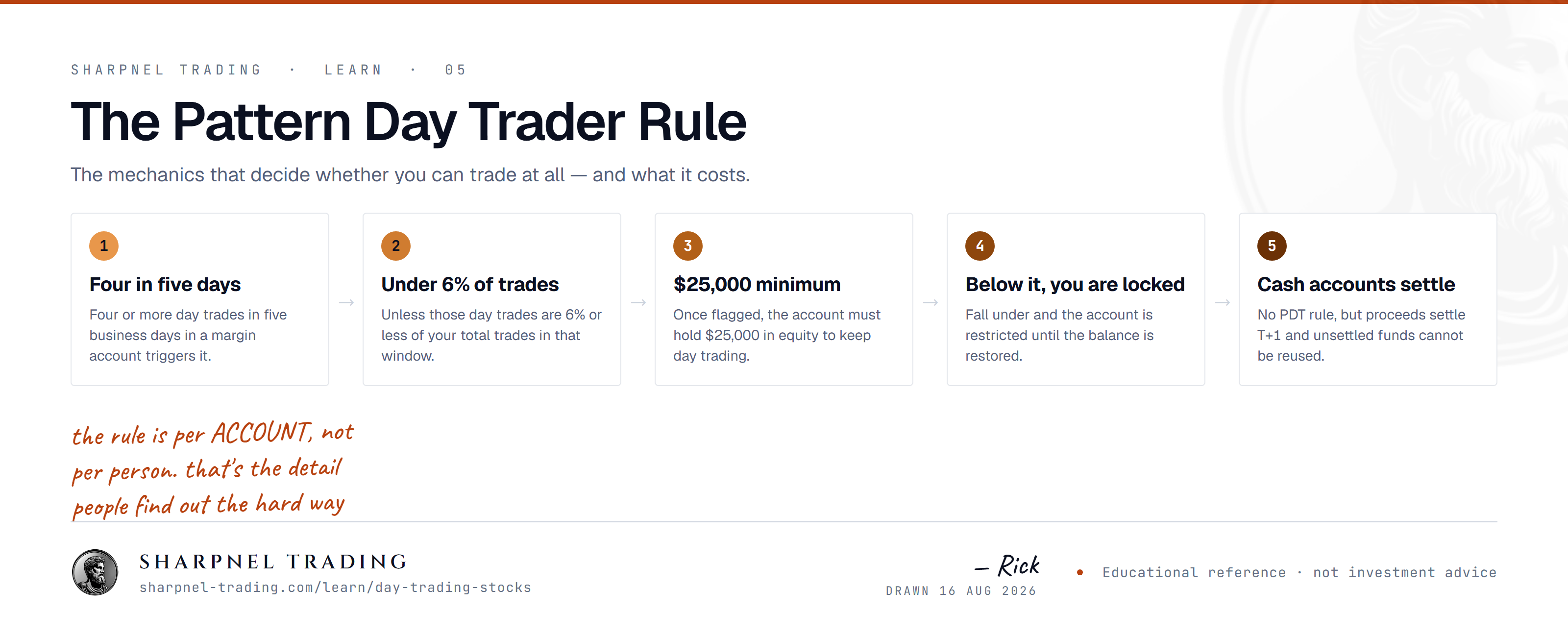
Day trading stocks means opening and closing equity positions inside a single session, carrying nothing overnight. In the United States this becomes regulated activity when done in a margin account: FINRA's pattern day trader (PDT) rule requires $25,000 of minimum account equity, and in exchange grants intraday buying power of up to four times maintenance margin excess. Which side of that $25,000 line an account sits on changes almost everything about how it can operate, down to whether stocks are the right instrument for intraday work at all.
The other decisive variable is friction. Commissions, regulatory fees, slippage, and short-locate costs are small numbers per share that compound into large numbers per month, and at the sizes a new account trades they routinely consume more than a strategy's gross edge. The arithmetic on that comes further down; the rule mechanics come first, because they set what an account is even permitted to attempt.
What the pattern day trader rule actually says
A day trade is the purchase and sale — or short sale and cover — of the same security in the same margin account on the same day. Options day trades count toward the tally. Under FINRA Rule 4210, an account becomes a pattern day trader when it places four or more day trades within five business days and those day trades exceed 6% of total trades over the same window. Brokers are allowed to flag an account sooner if they have a reasonable basis to.
Once flagged:
- The account must hold $25,000 of minimum equity (cash plus securities) before any further day trading. This is not an average. If equity closes below the threshold, day trading is restricted until it is restored.
- The threshold applies per account, and deposits made to satisfy it generally have to stay put for a period; brokers layer their own seasoning policies on withdrawals.
- The rule covers equities and equity options held in margin accounts. Futures accounts sit outside FINRA's PDT framework entirely, which is one structural reason small intraday accounts gravitate toward futures.
How 4x intraday buying power works
Day-trading buying power is up to four times the maintenance margin excess as of the close of the prior day. A hypothetical account holding $30,000 in cash with no positions has $30,000 of excess, so up to $120,000 of intraday exposure. Two mechanics catch people:
- The 4x is intraday only. Standard Reg T margin (2:1) governs overnight holds, and carrying a position opened on day-trading buying power past the close can itself trigger a margin call.
- Exceeding day-trading buying power triggers a day-trading margin call: five business days to meet it, buying power capped at 2x in the meantime, and an unmet call drops the account to cash-available terms for 90 days.
Trading under $25,000
Two paths exist. A cash account is exempt from the PDT rule, but U.S. equities settle T+1, so a sale's proceeds do not settle until the next business day — and while unsettled proceeds can be spent on a new purchase, selling that purchase before the original funds settle creates a good-faith violation, and those accumulate into restrictions. In practice a cash account turns its balance over about once per session. A margin account under $25,000 gets three day trades per rolling five business days before the flag; the fourth converts the account to PDT status with the equity requirement attached.
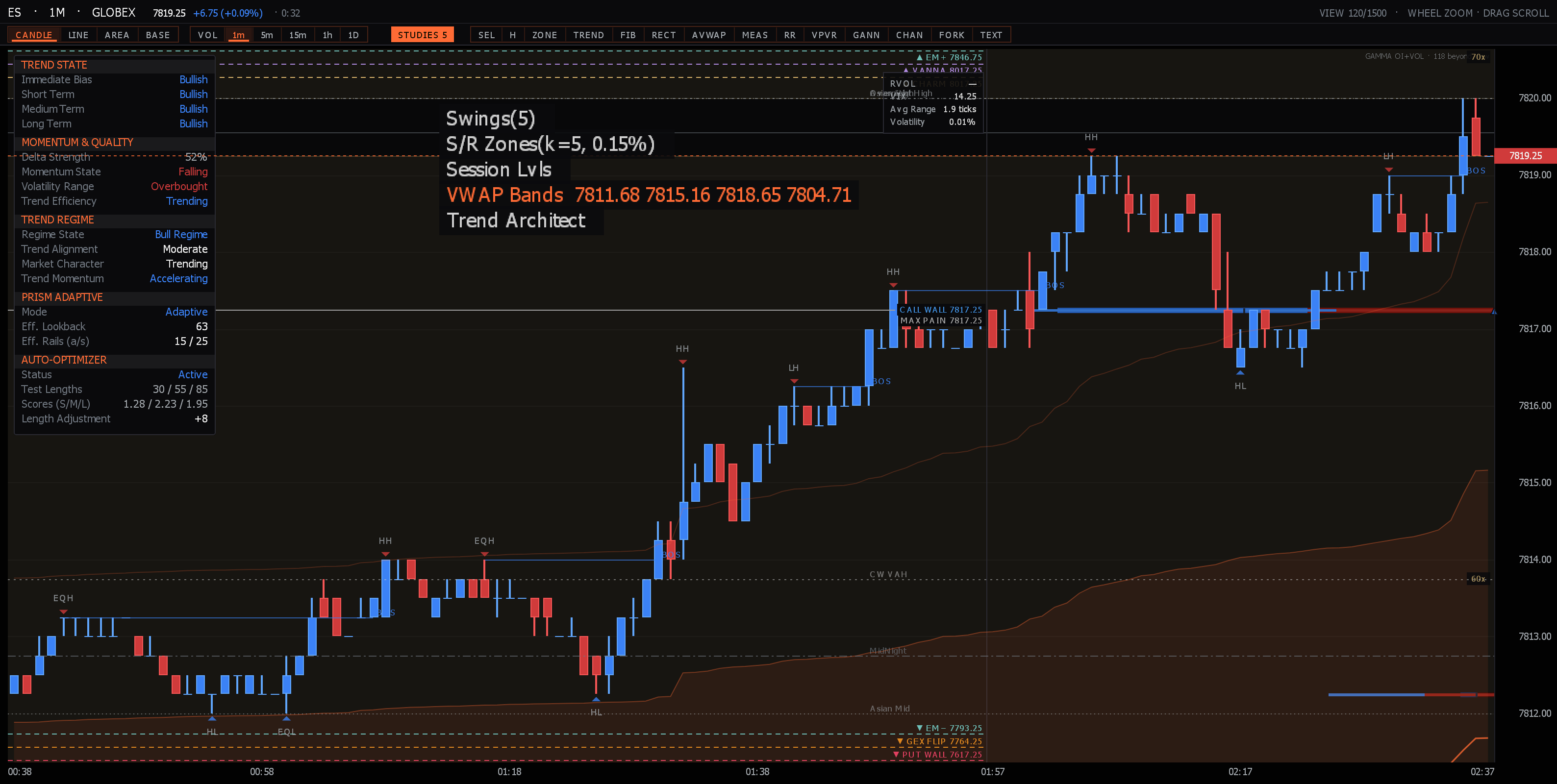
Three intraday structures, described neutrally
These are constructions, not recommendations. Each carries a recurring failure mode that shows up in real ledgers, and knowing the failure mode is worth more than knowing the entry.
Gap trades
A stock opens sharply away from the prior close on overnight news. The continuation version buys strength through the premarket high with a stop under the opening range, betting the gap extends. It fails when the news was fully priced before the bell and the opening drive is actually distribution — the entry prints near the high of the day and the stop is hit on the first pullback. The fade version shorts into the gap expecting a retrace toward the prior close; the recurring loss arrives when the news is a genuine repricing — changed guidance, a resolved binary event — and price builds a new value area at the higher level instead of filling. Both versions also pay a structural tax: spreads around the open are at their widest while depth is thinnest, so fills are worst at exactly the moment these trades trigger.
Momentum continuation
Buying the pullback or the flag in a stock already trending intraday, stop under the consolidation. The losses concentrate in two places. Late entries: by the time the trend is obvious, a pullback deep enough to offer "the next entry" is often deep enough to take out any reasonable stop first. Fast-tape slippage: stop orders in a momentum name fill at market, and in a genuinely fast move the fill can land several cents through the stop price — the modeled loss and the realized loss diverge on precisely the trades where it matters most. Whether buyers are still absorbing supply on a pullback is ultimately an order-flow question; cumulative delta is one lens on it.
VWAP fade
Shorting a stock stretched far above the session's volume-weighted average price — or buying one stretched far below — expecting reversion toward VWAP. On rotational days the construction behaves as designed. It loses decisively on trend days: price never reverts, and the setup quietly invites re-entry, so the second and third attempts "at an even better price" become the expensive ones. Three stop-outs against a trend day can hand back two weeks of small reversion wins, and averaging into the position converts a planned small loss into the day's defining one. Nothing inside the trade signals "this is a trend day"; the trader has to impose that judgment from outside it.
The cost arithmetic
Every number here is hypothetical and chosen for round math. Take a 500-share round trip with a commission of $0.005 per share each way: $2.50 in, $2.50 out, $5.00 total. Assume one cent per share of combined slippage across entry and exit: another $5.00. That is $10 of friction per round trip, or 2 cents per share the trade must capture before any profit exists. Regulatory sell-side fees (the SEC fee and FINRA's trading activity fee) add a small further amount.
Now scale it. Ten such round trips a day is $100 of friction daily — roughly $2,000 across a 20-session month. That figure is invariant to whether the trades win. An account that grosses $2,000 of edge in a month at that pace nets approximately zero.
Short selling adds locate costs. A hard-to-borrow name might run a hypothetical $0.02 per share to locate: $10 on 500 shares, paid before the position even exists, plus borrow interest while it is held. On a trade targeting $50 gross ($0.10 per share on 500 shares), the locate alone is 20% of the target, and locate plus standard friction is $20 — 40% of the target, before the outcome is known.
The structural point: friction is certain and charged per trade, while edge is uncertain and delivered per trade. Trade count is the one cost-side variable fully under the trader's control, which is why overtrading — not any single bad position — is the primary killer in most honest post-mortems.
The case for journaling every trade
Memory edits losing trades; it softens them and supplies better reasons than existed at the time. A journal is the version of the day that does not negotiate. The minimum useful record per trade: instrument, time, which structure it was (from a finite written list), entry, exit, initial stop, size, one sentence of reasoning written before the fill, and what price did after the exit.
After 50 to 100 entries the ledger starts answering questions screen time never settles: which structure actually carries the account's results, where in the session losses cluster, how often the initial stop was honored versus widened, how realized slippage compares with the assumption used in planning. A common and uncomfortable finding is that one setup subsidizes the other two, with the subsidized ones surviving only because each occasionally produces a memorable win. The journal also exposes rule drift — the widening gap between the plan as written and the trades as taken — while it is still cheap to correct, rather than when the equity curve makes it undeniable.
Founder note: I trade futures rather than stocks, but the mechanism transfers exactly. I grade every session against the plan I wrote before it, because a graded record argues back and my memory of the session will not.
For a small account the honest sequence runs backwards from cost. Establish what a month of intended trading costs in friction at the intended size; establish what the account's regulatory status permits; only then ask whether a structure exists whose realistic per-trade capture clears that friction with room to spare. Much of the controllable edge in retail day trading is the refusal of marginal trades, and the journal is the instrument that proves, entry by entry, whether that refusal is actually happening.