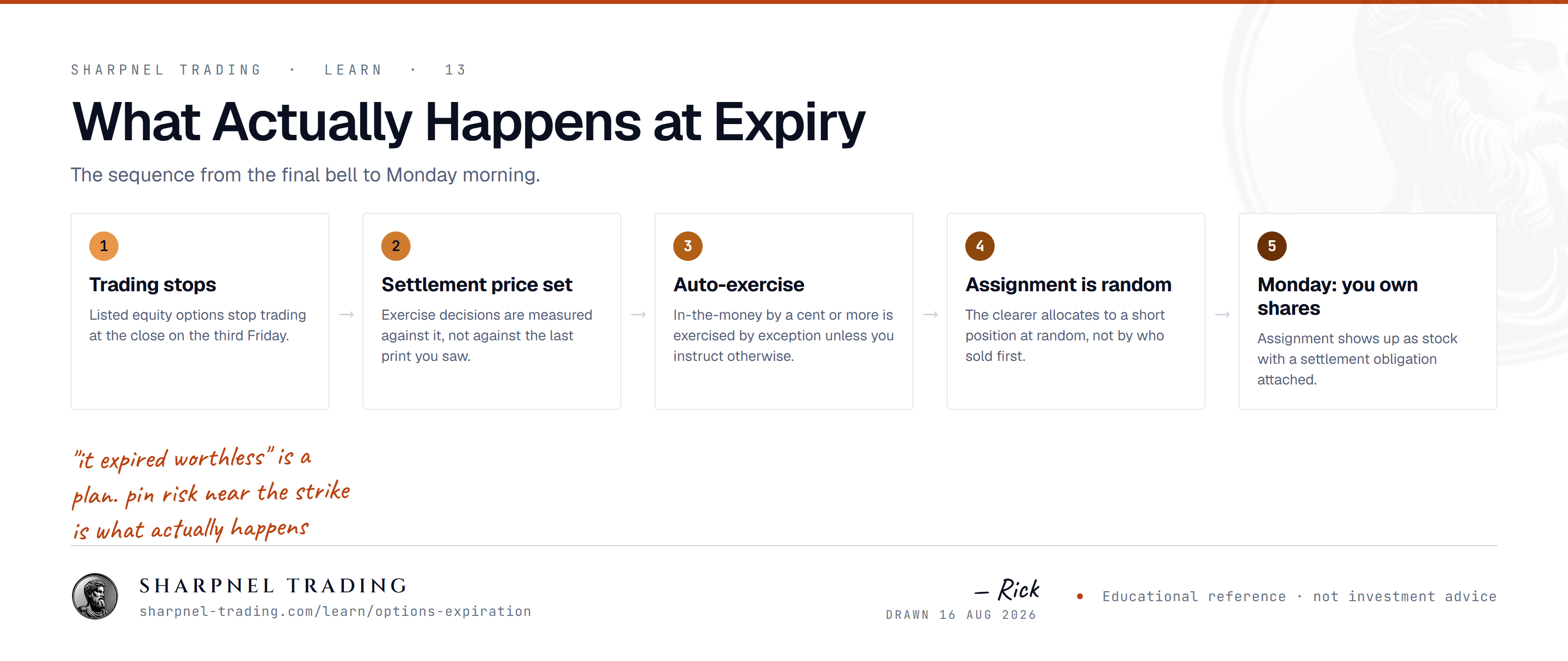
When an option reaches expiration, the Options Clearing Corporation (OCC) applies a procedure called exercise-by-exception: any equity or ETF option that finishes in the money by $0.01 or more — measured against the official closing price of the underlying on the last trading day — is exercised automatically unless the holder files contrary instructions. An in-the-money call becomes a purchase of 100 shares at the strike; an in-the-money put becomes a sale of 100 shares at the strike. Cash-settled index options skip delivery entirely and pay the difference between the settlement value and the strike, times the contract multiplier. Everything that finishes out of the money by the official measure expires unexercised and disappears from the account.
That is the clean answer. The expensive details live around the edges: the in-the-money determination uses the official close, but exercise decisions can still change for a window after the close; assignment notices are processed overnight, so short sellers learn their fate the next morning at the earliest; AM-settled and PM-settled products compute their final value at different moments; and on large expirations — especially 0DTE — the hedging attached to expiring open interest can bend the underlying itself.
The $0.01 rule in practice
Exercise-by-exception exists so a holder does not forfeit intrinsic value by forgetting to act; one cent in the money triggers it. What it does not guarantee is a profit. Suppose — hypothetically — you paid $1.20 ($120 per contract) for a 50-strike call and the stock closes expiration day at $50.01. The option is exercised automatically: you buy 100 shares at $50.00, an outlay of $5,000, and the position carries whatever the shares do next. The intrinsic value captured at the close was one cent, or $1 per contract, against $120 of premium paid — a $119 loss before the shares even trade again. Automatic exercise converts value; it does not create it.
Two practical wrinkles. First, if the account cannot support the resulting share position, many brokers close in-the-money options on expiration afternoon rather than allow exercise into a position the account cannot hold. Second, 100 shares is the deliverable only for standard contracts — options adjusted for corporate actions can deliver something else, and the adjusted terms govern.
The window after the close
Trading in an expiring equity option typically ends at 4:00 PM ET, but the exercise decision does not. Holders can submit contrary exercise instructions for some time afterward — declining exercise of an in-the-money option, or exercising one that finished out of the money at the bell because the stock moved in the after-hours session. Cutoff times vary by broker, and the clearing-level deadline is later than most retail cutoffs. This window is the legal root of pin risk: the closing print decides the default, not the outcome.
When assignment actually lands
Assignment is not real-time. Exercise notices are processed after the close: OCC allocates them among clearing firms carrying short open interest, and each firm then allocates to its short customers by an approved method — random or first-in, first-out. You learn you were assigned from your broker, generally before the next session begins; for a Friday expiration that usually means over the weekend. There is no interval in which you can trade out of the option — by the time the notice exists, the option does not.
Delivery itself runs through the regular equity settlement cycle — currently T+1 in the U.S. Adjacent note: standard equity options are American-style, so assignment can also arrive before expiration — most commonly on deep in-the-money calls the day before an ex-dividend date. Expiration week concentrates that risk.
Pin risk
Pin risk is what a short position faces when the underlying finishes at or very near the strike. Hypothetically: you are short a 100-strike put and the stock closes expiration Friday at $100.02. At the closing print the put is out of the money and the default is non-exercise. Then a headline drops the stock to $98.60 in after-hours trading, and holders file contrary instructions before their cutoff. You come in Monday long 100 shares bought at $100.00 with the stock at $98.60 — an unrealized loss of $140 per contract on a position you believed had expired dead, plus open exposure until you can act at the next session.
The management choices each cost something. Buying back the short option before the close pays the remaining premium and the spread — money wasted whenever the option would have expired worthless anyway. Holding through the close saves that premium and accepts the after-hours assignment lottery plus the weekend gap. No version risks nothing; the honest framing is choosing which loss you can size in advance. My own rule as a trader: an unhedged short option sitting within a strike's width of spot in the last hour is a risk decision, not an income decision, and I handle it before the market does.
AM versus PM settlement
PM-settled options compute their settlement value from the underlying's official close on expiration day, and the option trades into that close. What you see in the final minutes is essentially the number that settles you.
AM-settled options are stranger. The last trade in the option is the prior day's close; the settlement value is computed the next morning from the opening print of each component of the index. That creates two gaps. First, you hold overnight exposure you cannot adjust in the option itself. Second, the settlement value is not the index quote you see at 9:30 — components open one by one, so the official figure can land meaningfully away from both the prior close and where the index appeared to open. In the U.S. cash index complex, the traditional third-Friday expirations are commonly AM-settled, while the weekly and end-of-month listings that carry the 0DTE ecosystem are PM-settled. Knowing which one you hold is not optional.
Cash settlement versus share delivery
Equity and ETF options settle by physical delivery: shares move, and a position in the underlying appears. Cash-settled index options resolve to money. Nearly all of them are also European-style — exercisable only at expiration — which removes early assignment as a structural possibility; a handful of legacy American-style cash-settled listings survive, so the contract specifications still deserve a look.
A hypothetical cash settlement: you hold a 5,000-strike index call with a $100 multiplier and the official settlement value prints 5,043.50. The contract pays (5,043.50 − 5,000) × $100 = $4,350, credited as cash. If you paid $12.00 in premium ($1,200), the net result is a $3,150 gain. Had the settlement value printed at 5,000.00 or below, the same contract would pay nothing and the full $1,200 of premium would be the realized loss.
Options on futures
Options on futures clear through the futures clearinghouse rather than OCC, and the conventions are product-specific. Most exercise into a futures position at the strike; a quarterly option that expires at the same moment its underlying future is marked to final settlement effectively resolves to cash. Automatic-exercise and abandonment rules differ by product, so the exchange's contract specifications page — CME's, for the major U.S. futures options — is the authority, not habits carried over from the equity side.
What expiration does to the underlying
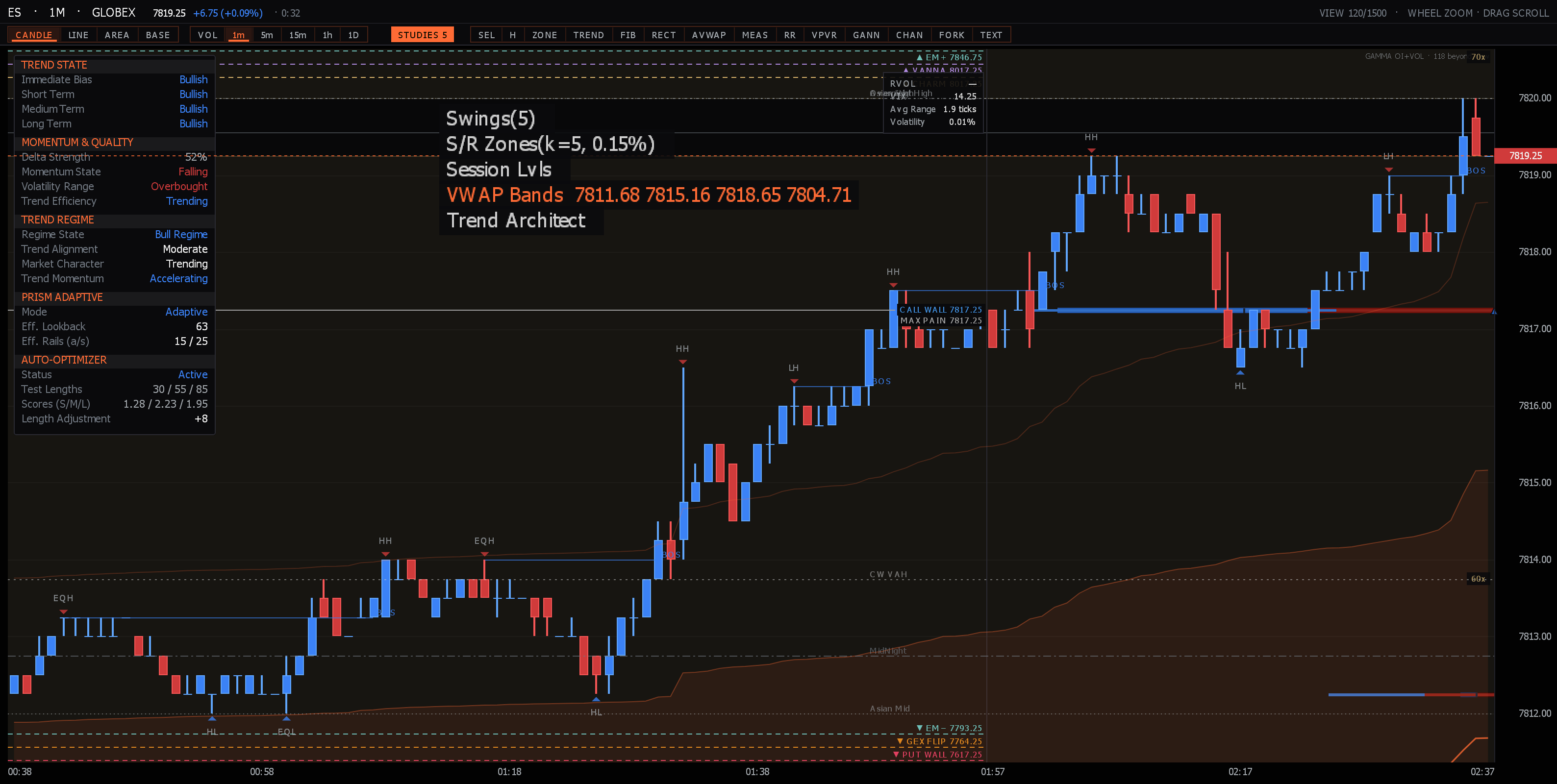
An option's gamma concentrates as expiration approaches: near the strike, delta snaps toward 0 or ±1 over smaller and smaller price increments. Dealers carrying the other side of expiring open interest must rebalance hedges against those snapping deltas, and on the largest expirations that flow is big enough to shape the tape. When dealers are net long gamma around a heavily held strike, their hedging leans against movement — selling as price lifts off the strike, buying as it falls back — which produces the familiar magnetism of price pinning to big open-interest strikes into the close. When positioning flips short gamma, the same mechanics run in reverse and hedging chases price, extending moves instead of damping them. A live read on which regime is in force is exactly what gamma exposure maps attempt.
Two timing effects matter on the day. Delta decay (charm) accelerates in the final hours, forcing steady hedge adjustments even while price sits still. Then the settlement print removes the expiring open interest entirely: hedges tied to it unwind, and the next session opens against a materially different gamma profile. A level that behaved like a wall on Friday can be inert on Monday because the options that made it a wall no longer exist.
Both readings fail in specific ways. Positioning for a pin loses when a late catalyst overwhelms the hedging flow and price leaves the strike behind — the pin was a tendency, never a guarantee. Riding short-gamma acceleration loses when the flow finishes before the close and price mean-reverts through the entry. Expiration mechanics describe pressure on price; they never dictate its path.
A pre-expiration checklist
- Confirm the settlement style — AM or PM, cash or delivery — from the contract specifications before the session starts.
- Decide before the close what happens to any short option within roughly a strike's width of spot; after the bell the decision belongs to the holders.
- Treat out-of-the-money as provisional until the exercise cutoff has passed, and expect assignment notices overnight rather than live.
- Check that the account can actually carry the delivered position; a broker will resolve that question for you on expiration afternoon otherwise.
- Assume the dealer-positioning map resets at the settlement print, and re-read your levels fresh in the next session.