LEAPS are exchange-listed options with expirations set a year or more in the future. The acronym — Long-term Equity AnticiPation Securities — dates to their 1990 introduction, and the label now attaches to any long-dated listing, whether on a single stock or on an index product. Mechanically a LEAPS is a standard contract: the same strike grid and exercise rules, cleared the same way as any near-dated series.
What changes with time is the balance of the Greeks. A 30-day option lives and dies by gamma and theta; a two-year option is dominated by delta and vega, with a dose of interest-rate sensitivity (rho) that short-dated traders never have to think about. The practical use case: holding directional exposure for months without surrendering meaningful time value every session — most commonly through the stock-replacement structure below, where a deep in-the-money call stands in for shares at a fraction of the capital.
What Counts as a LEAPS
Exchanges list LEAPS series out to roughly three years on many optionable stocks and ETFs; some index products extend further still. Once listed, a LEAPS is indistinguishable from any other series on the chain — a contract that was a LEAPS two years ago is simply a front-month option today.
Settlement style is worth pinning down before trading these:
- Equity and ETF options are American-style and physically settled. Exercise delivers 100 shares per contract and is permitted on any day up to expiration.
- Cash-index options (the SPX complex is the classic case) are European-style and cash-settled — no early exercise and no share delivery; settlement is a cash difference at expiration.
The Theta Profile: Where Decay Concentrates
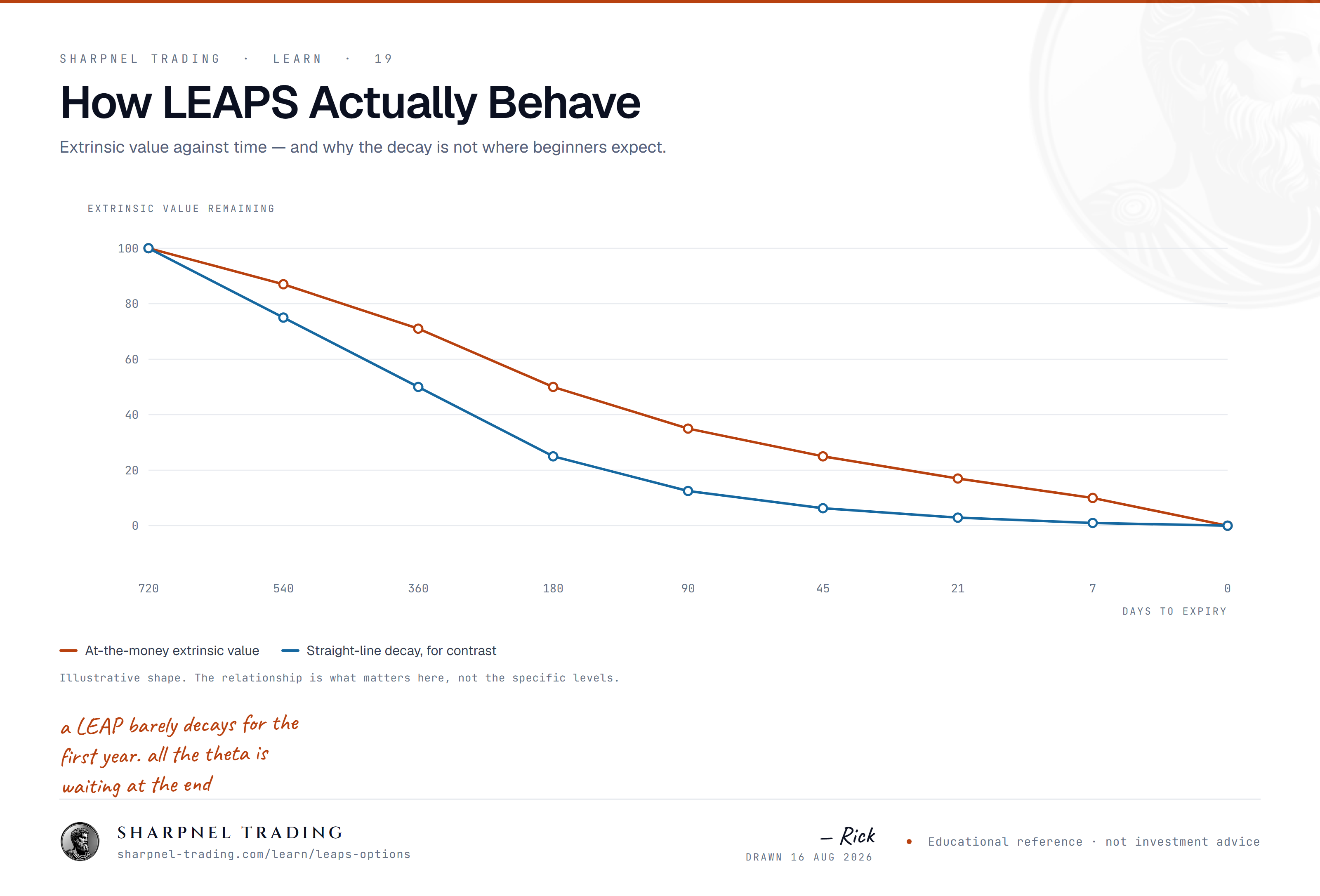
An at-the-money option's value scales roughly with the square root of time to expiration (holding volatility and carry inputs fixed — an approximation, not a law). Say a hypothetical one-month at-the-money call costs $4.00. The square-root rule puts the twelve-month call near $4.00 × √12 ≈ $13.90 — call it $14 — not $48. You pay about 3.5× the premium for 12× the calendar. Averaged out, the twelve-month option gives up roughly four cents a day while the one-month option gives up about thirteen. The decay is also not evenly distributed: at-the-money decay accelerates hard into the final weeks, so a LEAPS holder spends most of the position's life on the flat segment of the curve. The violent end of that same curve is where 0DTE trading lives — the opposite corner of the term structure.
The honest caveat: slow decay is not free. Long-dated options carry the largest vega on the chain. If implied volatility drops two points, the mark on a two-year call can fall by more than a month of theta would have cost. Rho cuts the same way — a long-dated call gains when rates rise and loses when they fall, a sensitivity that rounds to zero on a weekly but is real money at 24 months. A LEAPS position is a volatility-and-rates position whether you intended one or not, and a correct directional view can still show a losing mark for months if the volatility surface deflates underneath it.
Stock Replacement: The Core LEAPS Structure
Stock replacement buys a deep in-the-money LEAPS call — commonly 0.80 delta or higher — instead of holding shares. A worked example, every number hypothetical:
- Say a stock trades at $200 and the 24-month $140-strike call is offered at $72: that price is $60 of intrinsic value plus $12 of extrinsic.
- 100 shares tie up $20,000. One call ties up $7,200 — about 36% of the capital for roughly 85% of the near-term price sensitivity at 0.85 delta.
- Stock at $260 at expiration: the call is worth $120. That is a $48-per-share gain, $4,800 on $7,200 committed — 66.7%, versus 30% for the shareholder ($6,000 on $20,000).
- Stock flat at $200: the call is worth its $60 intrinsic. You lose the $12 of extrinsic — $1,200 — while the shareholder loses nothing and collected any dividends along the way.
- Stock at $140 or lower: the call expires worthless and the full $7,200 is gone, a 100% loss. The shareholder is down $6,000 at $140 — and below $128 the share position loses more in dollars than the call ever can. That floor is what the extrinsic bought.
Delta Selection: Choosing the Exposure
Delta is the practical dial on a LEAPS position, and long-dated deltas are stable — gamma is small far from expiration, so the delta you buy is close to the delta you keep for months.
- 0.80–0.90 delta (deep in the money). Mostly intrinsic value with a small extrinsic outlay; it behaves like the underlying. This is the stock-replacement zone. The dollar risk is concentrated: maximum loss is the full premium, which is large precisely because intrinsic is large.
- 0.60–0.70 delta. More leverage per dollar committed, with meaningfully more extrinsic exposed to decay and volatility. The position starts caring about the surface as much as the direction.
- At the money and below (≤0.50 delta). Here the premium is mostly extrinsic. A two-year 0.40-delta call is closer to a term bet on realized upside plus implied volatility than to a share proxy, and a sideways underlying grinds it down even with all that time remaining. Buyers routinely underestimate how far the underlying must travel just to break even at expiration.
Rolling and the Diagonal Variant
Because at-the-money decay steepens late, a common management practice is rolling a LEAPS to a new long-dated expiration while nine or more months remain rather than riding it into the steep zone. Rolling is never free — each roll pays a fresh slice of extrinsic — but it keeps the position on the slow part of the curve.
The well-known variant sells short-dated calls against the long LEAPS call: the diagonal nicknamed the "poor man's covered call." The short call's fast decay subsidizes the long call's slow decay. Its failure mode is a sharp rally through the short strike — the short call's delta races toward 1.0 and caps the structure's gains near that strike, so a correct directional read can produce a mediocre outcome. A hard sell-off, meanwhile, loses on the long call far faster than accumulated short-call premium offsets. Anyone describing this structure as "income" is describing the calm months only.
Tax Notes — General Treatment Only
Tax treatment varies by jurisdiction and by personal circumstance; what follows describes common US frameworks in general terms and is not advice.
- Holding period. LEAPS are among the few option positions that can be held longer than twelve months, so a gain on the sale of an equity or ETF LEAPS held past a year can qualify for long-term capital-gains treatment. Selling at eleven months versus thirteen can change the rate applied to the same gain.
- Broad-based index options. Options on broad-based cash indexes generally fall under Section 1256: gains treated as 60% long-term and 40% short-term regardless of holding period, with open positions marked to market at year-end. The holding-period arithmetic above simply does not apply there.
- Exercise. Exercising a LEAPS call folds the premium into the stock's cost basis, and the shares' holding period begins at exercise — the months you held the option do not carry over.
- Worthless expiration and wash sales. A LEAPS that expires worthless is a capital loss realized at expiration, and wash-sale rules can reach option positions much as they reach shares.
Where LEAPS Fit for a Futures-First Trader
If the day book is index futures, LEAPS sit on a different shelf entirely. Futures give linear exposure with daily variation margin and no expiration-shaped payoff; a deep in-the-money LEAPS call gives comparable directional exposure with the maximum loss fixed at the premium paid and no daily cash flows against the position. The price of that floor is the extrinsic paid up front plus the volatility and rate exposure inherited with it.
The clean mental model: a LEAPS is a financed, risk-limited position in the underlying with a volatility rider attached. The trades that end badly are usually the ones where the buyer priced the direction and ignored the rider.