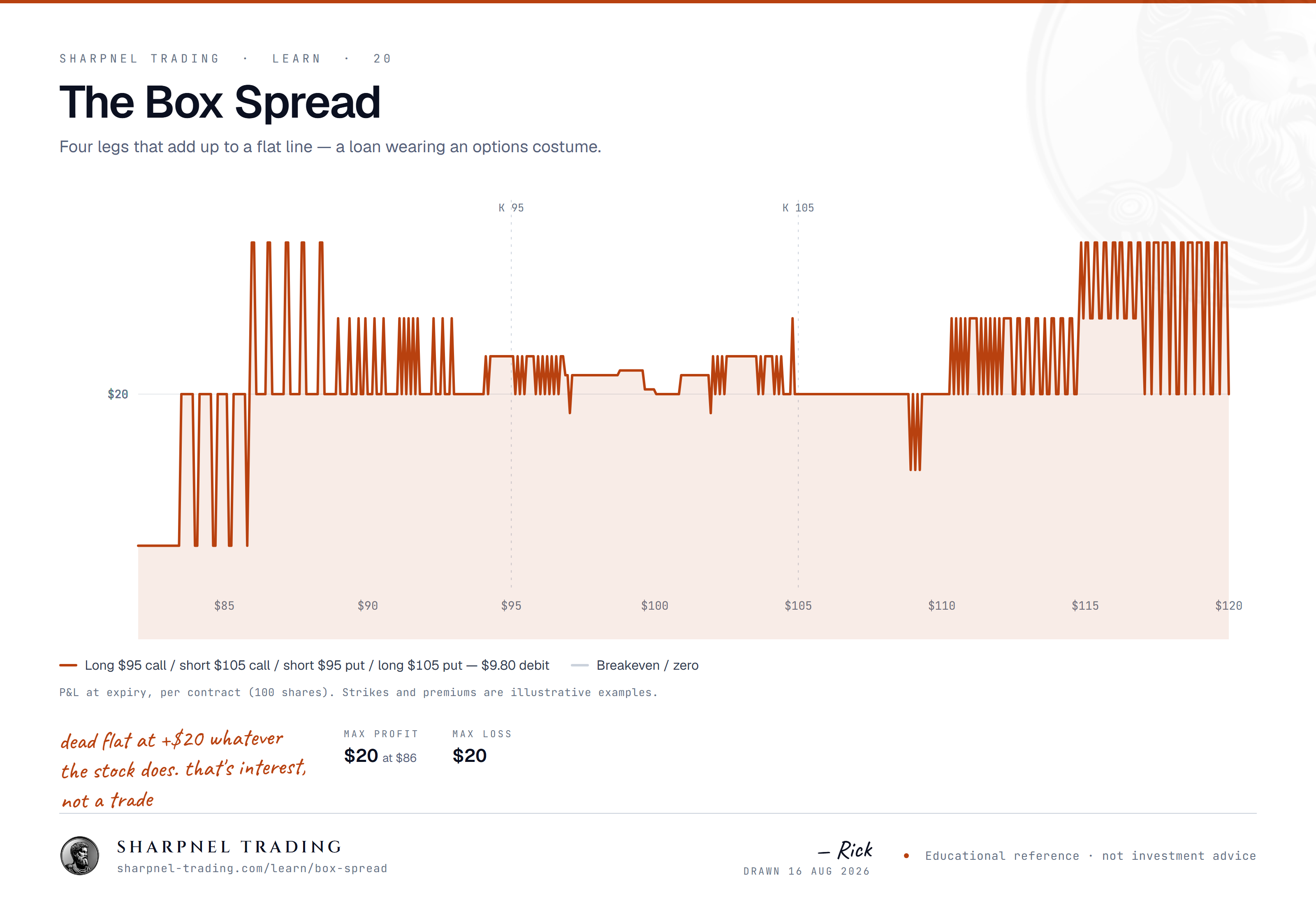
A box spread is a four-legged options position whose value at expiration is fixed in advance: a bull call spread plus a bear put spread on the same two strikes, same expiration. Long the lower-strike call, short the higher-strike call, long the higher-strike put, short the lower-strike put. Wherever the underlying finishes, the package settles at exactly the distance between the strikes. A payoff that cannot move is not a directional trade at all — it is a zero-coupon loan wearing an options costume. Buying the box lends money until expiration; selling it borrows.
That framing answers the two questions that usually bring people here. First: no, a box is not free money. The price you pay or collect already embeds an interest rate, and at retail size that rate is usually worse than the boring alternatives once fees are counted. Second: the horror stories are real, but they share a single cause — running the structure on American-style options, where early assignment can tear the box apart long before expiration. Everything below is detail on those two sentences.
The construction, leg by leg
Work through an explicitly hypothetical example. Say SPX trades near 5,600 and you build a 90-day box on the 5,500/5,700 strikes:
- Buy the 5,500 call
- Sell the 5,700 call
- Buy the 5,700 put
- Sell the 5,500 put
- 5,400 — both calls expire worthless; the long 5,700 put is worth 300, the short 5,500 put costs you 100. Net: 200 points.
- 5,600 — the call spread is worth 100, the put spread is worth 100. Net: 200 points.
- 5,800 — the long 5,500 call is worth 300, the short 5,700 call costs you 100; both puts expire worthless. Net: 200 points.
The price is an interest rate
If the ending value is fixed, the only question is what you pay today. Suppose the four legs price as a package at 197.50 points, or $19,750. You hand over $19,750 now and receive $20,000 in 90 days. The $250 difference is about 1.27% over the period, which annualizes to roughly 5.1% (multiply by 365/90). That figure is the box's implied financing rate. The buyer has lent $19,750 at about 5.1%; the seller has borrowed the same money at the same rate.
This is why boxes exist. Index boxes clear through a central clearinghouse, so the loan is effectively collateralized, and implied box rates tend to track short-term funding benchmarks — often within shouting distance of Treasury bills. When the box rate drifts away from bill yields, that gap is information about funding conditions, not about the index.
Even the European version has ways to lose:
- Overpay on entry and you have locked a below-market rate for the whole term.
- If rates rise after entry, the present value of the fixed payout falls — an early exit realizes a mark-to-market loss on a "riskless" position.
- Friction: four legs of commissions plus spread give-up. On a $20,000 box carrying $250 of gross interest, losing half a point on execution costs $50 — a fifth of the trade's entire edge.
- Opportunity cost: a bill ladder or money-market sweep may simply pay more with none of the legwork.
European vs American: the load-bearing detail
European-style options — SPX index options are the canonical example — cannot be exercised before expiration, and the major index products pair that with cash settlement. Nobody can call your short legs away early, so the box stays welded together until it pays out, and no shares ever change hands. This is the only environment where "fixed payoff" is literally true.
American-style options — equity and ETF options, plus most options on futures — can be exercised by the holder at any time. That right matters most on deep in-the-money contracts, which is precisely what a box's legs become once the underlying moves. When a deep-ITM option's extrinsic value approaches zero, early exercise turns rational for its owner: deep calls get exercised ahead of ex-dividend dates, deep puts when interest on the strike proceeds beats the remaining time value. Your short legs are somebody else's longs. You don't get a vote.
Assignment is not a paperwork event. It converts one leg into a stock position overnight, so the margin requirement changes shape while you sleep. A short stock position can start accruing borrow fees. The remaining three legs no longer hedge you fully, and the exit runs through deep-ITM quotes whose spreads are often wide enough to charge you several times the box's theoretical edge.
The 2019 blowup, in mechanism
Early in 2019, a retail trader at a commission-free brokerage sold long-dated boxes on a leveraged volatility ETF and posted the position publicly as a can't-lose trade. The options were American-style, and the deep-ITM legs were almost pure intrinsic value. Holders on the other side exercised early. The box came apart, and an account funded with about $5,000 finished roughly $58,000 in the hole. The brokerage blocked the structure for retail accounts shortly afterward.
The takeaway is narrow but absolute: a short box on American-style options is not a box. It is a collection of short deep-ITM options whose worst case is not bounded by the strike distance. A related trap: most options on futures are American-style and exercise into a futures position, so an index-options habit does not transfer to the futures chain automatically. The exercise-style line in the contract specification is one line long, and it is the entire risk.
Who actually uses box spreads
- Cash-rich institutions, as lenders. Desks with idle cash buy index boxes in large size as a bill-like instrument. Large box prints are a daily fixture on the SPX chain, and at institutional size the implied rate has historically run close to short-term government yields.
- Borrowers on portfolio margin. A trader who wants cash against an existing book can sell a box instead of taking a margin loan, sometimes at a materially lower implied rate. This works only in an account that recognizes the four legs as one offsetting package — Reg T treatment frequently does not, and without that netting the margin requirement erases the point. Get the treatment in writing before selling.
- Rate watchers. Because a box strips out direction entirely — net delta zero and net gamma zero, the greeks cancel by construction — its price is a clean read on financing. I keep a 90-day index box quote on a watchlist purely as a funding thermometer: when its implied rate gaps away from bill yields, something is moving in the plumbing, and it tends to show up in index volatility and order flow before the headlines explain it. The cancellation also makes the box a useful contrast object — nearly everything else I build, gamma exposure tooling included, measures exactly the risks a box is engineered not to have.
- Retail traders, rarely. At one or two boxes of size, execution friction dominates the interest edge. The structure scales beautifully at institutional notional and poorly at retail notional — the reverse of most defined-risk spreads.
A checklist before touching one
- Exercise style, from the spec. European or American, read from the exchange's contract specification — not from memory, not from a forum.
- Settlement method. Cash-settled index boxes never touch shares. Physically settled boxes can hand you a stock position at the worst possible moment.
- The implied rate, annualized. Price the package and compute the rate. Compare it against what your idle cash earns (long box) or what your margin loan costs (short box). If you cannot compute it, you cannot evaluate the trade.
- The exit path. A box held to expiration realizes its rate; a box exited early realizes whatever rates have done since entry. Fixed payout is not fixed price.
- Margin treatment. How does your account type margin the short side? The answer varies by broker more than any other input here.
- Total friction. Four fills in, and four more if you leave early. Sum the commissions and half-spreads before comparing that hypothetical 5.1% to anything.