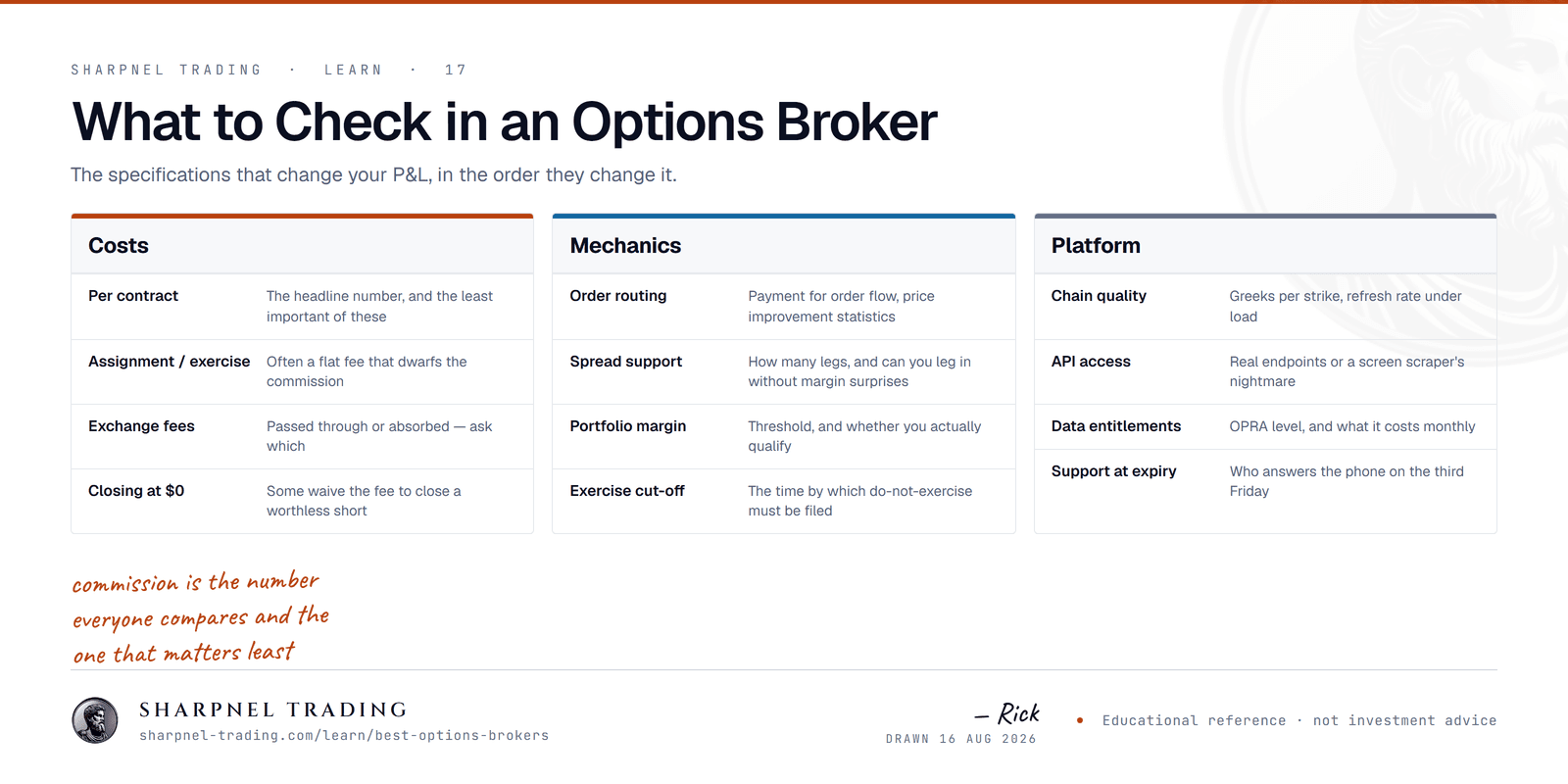
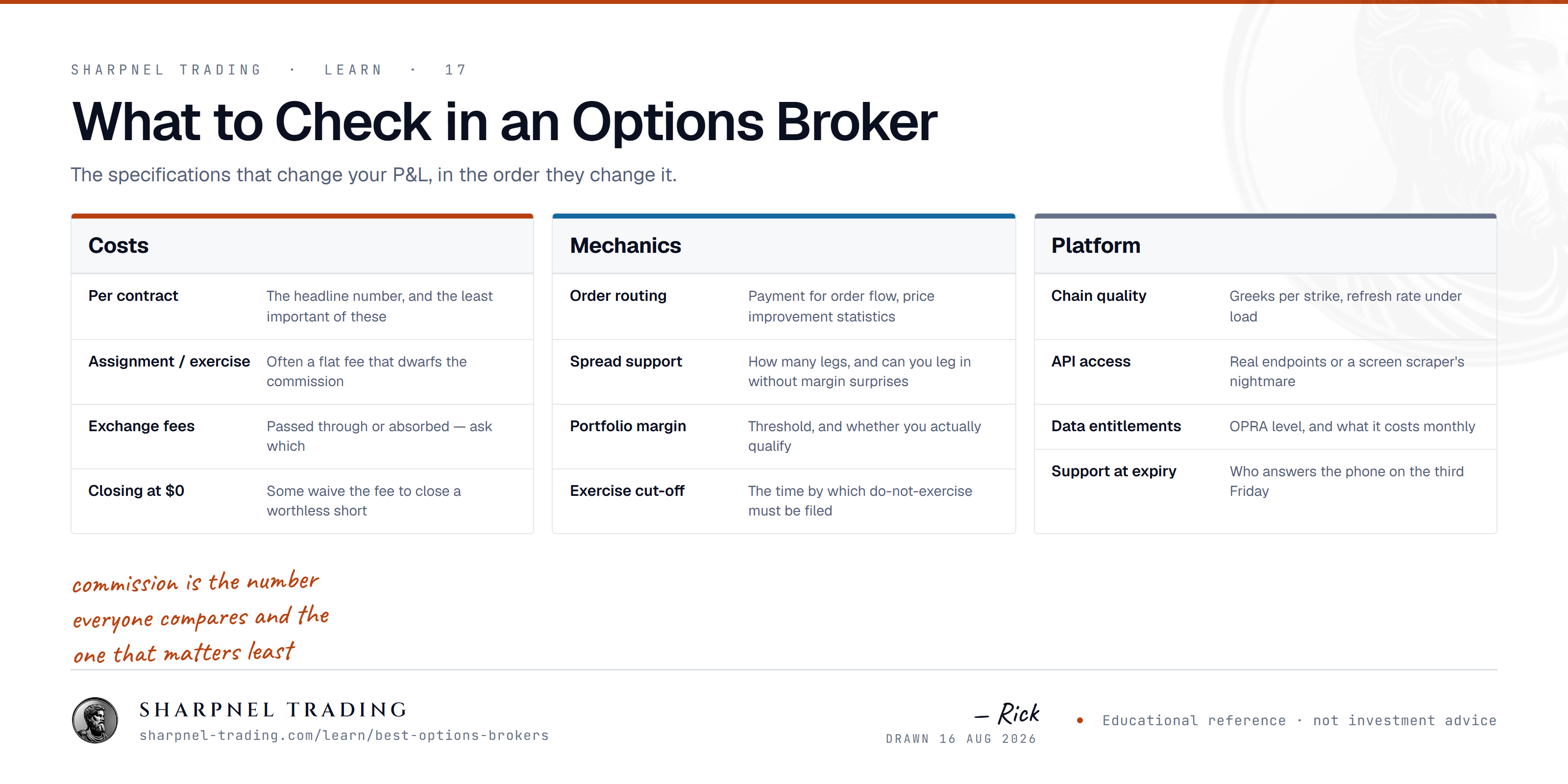
Assignment handling: where brokers genuinely differ
American-style equity options can be assigned any day the holder chooses, not just at expiration. When a holder exercises, the OCC allocates the exercise notice among clearing member firms by random process, and each firm then assigns it to individual short accounts using an approved method, typically random allocation. You cannot control whether you're picked. You can control which broker's process you're standing in when it happens.
Three questions worth asking a live human before funding:
- When do I find out? Assignment processes overnight. Some firms notify before the pre-market opens; at others you discover it when you look. On an ex-dividend morning, those hours are the difference between managing a position and eating a loss.
- What happens if the resulting position exceeds my buying power? Assignment on one short put means buying 100 shares per contract. Some brokers issue a margin call and give you the session to resolve it; others auto-liquidate on their own schedule.
- What does the expiration risk desk do in practice? Nearly every firm reserves the right to close positions on expiration day if the account can't support potential assignment. Ask how late in the session they act and whether anyone calls you first. Ask whether they close the whole spread or only the short leg. The reserved right is standard language; its application varies enormously.
What loses money here: a short call carried through an ex-dividend date when the dividend exceeds the option's remaining extrinsic value — it gets exercised against you, and you wake up short stock and owing the dividend. Or the short leg of a spread assigned early while the long leg stays open, converting a defined-risk trade into stock plus an option overnight. Neither event is the broker's fault. The broker decides how much room you get to fix it.
Exercise policy: know the cutoffs cold
At expiration, the OCC auto-exercises any equity option in the money by $0.01 or more unless it receives contrary instructions. Two details around that rule are broker-specific:
- The contrary-instruction cutoff. Each firm sets its own deadline for "exercise my out-of-the-money option" or "let my in-the-money option lapse," and every retail cutoff lands earlier than the OCC's own. If the underlying makes a sharp after-hours move on expiration Friday, whether you can respond depends on your broker's cutoff — and if you're short, whether the holder on the other side can. That is pin risk, and on 0DTE size it's real money.
- Product type changes the regime. Standard equity options are American-style and physically delivered. Broad-based index options such as SPX are European-style and cash-settled — no early assignment, and the traditional monthly contracts settle to a morning print while the weeklies settle to the close, which are different numbers on a volatile day. Options on futures generally exercise into a futures position carrying its own margin requirement, and exercise style varies by listing even within a single product family — verify the specific contract's specs rather than assuming. A broker's ability to explain these differences on the phone is itself a signal.
If a representative can't state the firm's contrary-exercise cutoff without checking, you've just learned how that firm treats expiration.
Data quality: the quiet differentiator
Broker data costs hide well because nothing about them appears on a statement. Verify these before trusting a feed:
- Streaming versus snapshot quotes. Some brokers stream true tick-by-tick option quotes; others conflate updates or refresh chains on a timer. On a fast open, a conflated chain shows you a market that no longer exists.
- Top-of-book versus depth. The options NBBO is a starting point, but for the underlying you want real depth of market — in futures especially, the book shows where size is resting.
- Greeks provenance. Broker-displayed Greeks are computed from the broker's own quote snapshot under the broker's model assumptions. If the quotes lag, the Greeks lag. I run exposure math from the chain itself rather than trusting a vendor rollup — a stale gamma exposure figure is worse than none at all.
- Entitlements. Real-time futures and futures-options data usually means monthly exchange subscriptions, and misreporting professional status is a compliance problem rather than a loophole. Price required subscriptions into the comparison before declaring any firm the cheap option.
A practical test: run the broker's feed into your charting platform beside a second source for a week and watch the first half hour of each session. Divergence there tells you more than any specification sheet.
API access: judge it by building something small
If automation matters to you, the API is the product, not a checkbox. The spread across firms is enormous:
- Interactive Brokers offers multiple routes in, from a desktop-gateway API up to FIX connectivity at higher tiers, with the widest product coverage and the steepest learning curve.
- Tradier was built API-first; if the use case is options data and order routing over plain REST, it's the shortest path.
- tastytrade and Schwab both expose retail APIs. Coverage and rate limits change often enough that current documentation beats any article, this one included.
Before real size touches an endpoint, test order placement and cancel-replace latency, behavior at the rate limit (throttled or hard-rejected?), whether streaming market data rides the same credentials, and whether the paper environment faithfully mirrors production. Then test the failure path: what your code sees when an order rejects, and what it does when a position appears in the account that it never opened — which is exactly what assignment looks like to an unprepared system. Automated strategies rarely break on the happy path; they break when reality changes account state the code assumed was static.
A funding-day protocol
Audition the firm before you commit to it:
- Fund the minimum. Trade one small defined-risk spread in a liquid product and deliberately hold a leg through expiration to watch the mechanics end to end.
- Call the desk twice — once pre-market, once mid-session — with a specific expiration question. Time the hold and grade the answer.
- If you'll automate, build the smallest possible tool against the API — a chain snapshotter is a fine test — before writing any order logic.
- Only then consolidate size, and keep a funded second account at another firm. Outages cluster on the highest-volume sessions, which are precisely the sessions you can't afford to sit out.
The best options broker is the one whose behavior in the ugly ten minutes — an assignment notice, a pinned strike at expiry — you've already tested cheaply. Everything else is a pricing page.