A Worked Example (Hypothetical Numbers)
Every price below is invented for clean arithmetic — none is a quote or a level. Say an equity index future trades at 5000, its options carry a $50-per-point multiplier, and you put on a call 1x2:
- Buy 1 call at the 5050 strike for 40.00 points ($2,000 paid).
- Sell 2 calls at the 5100 strike for 22.00 points each ($2,200 collected).
Net: a 4.00-point credit, or $200.
At expiration:
- At or below 5050: all three options expire worthless. You keep the $200.
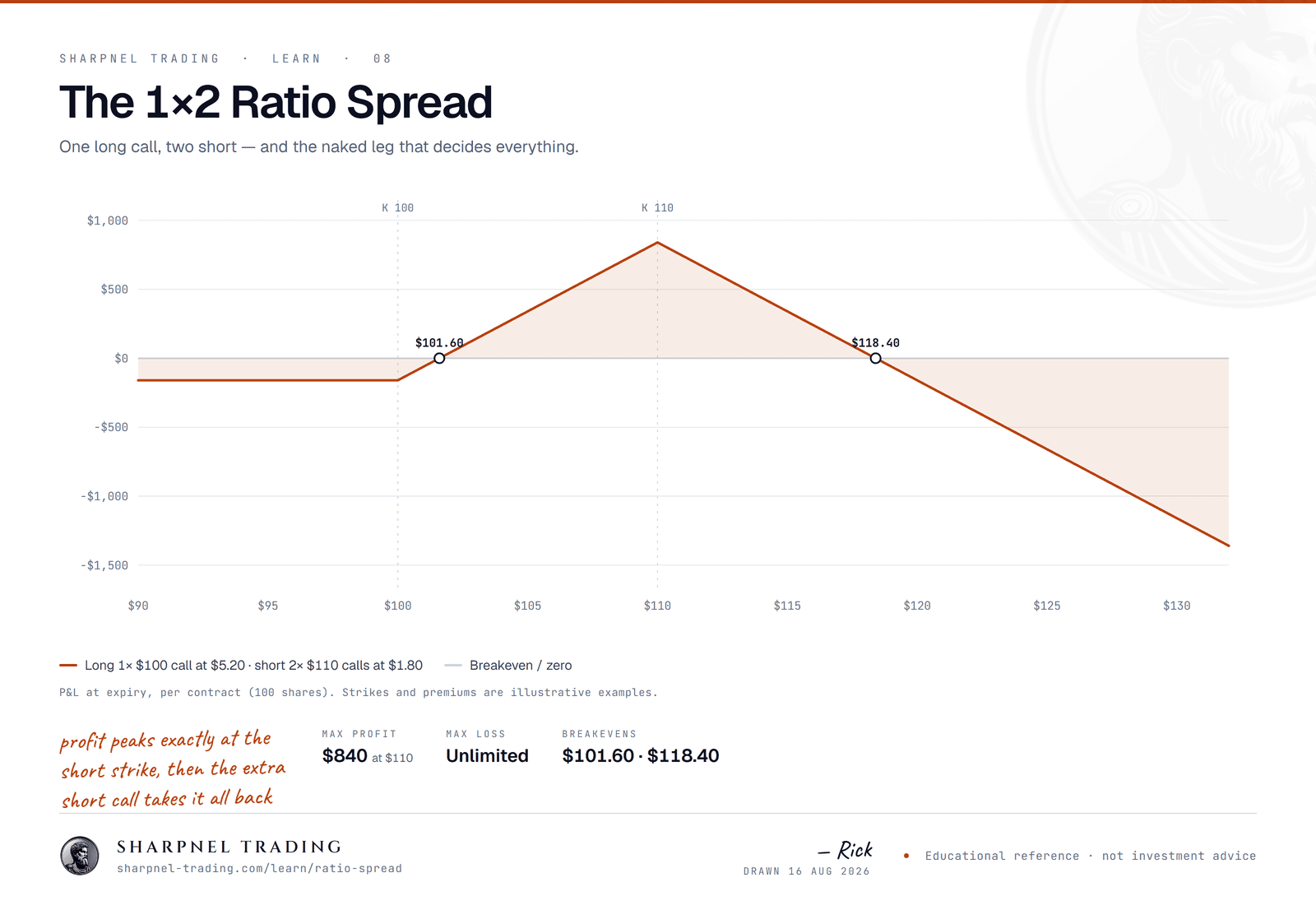
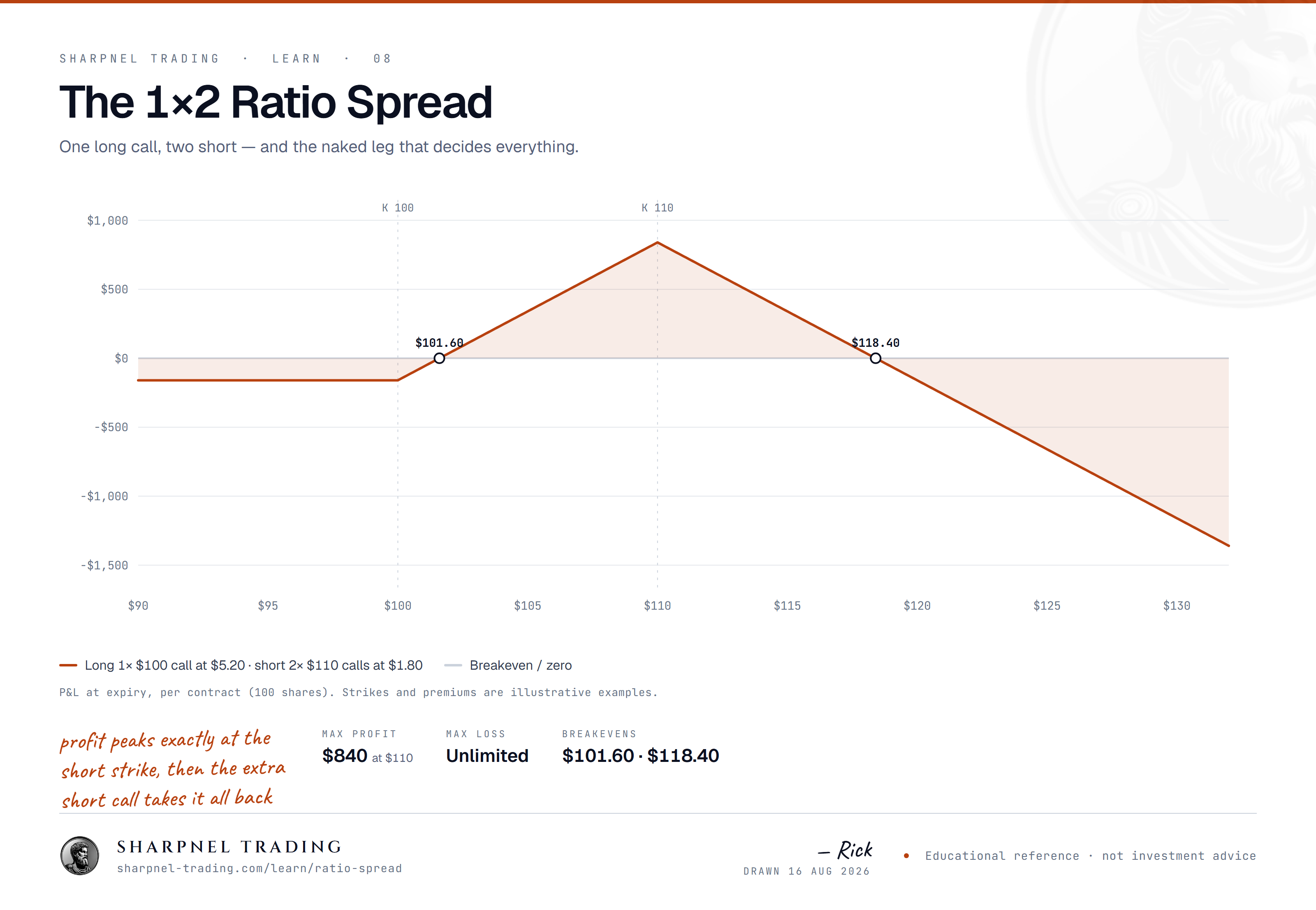
- At 5100: the long call is worth 50, the shorts die at zero: 50 + 4 = 54 points, $2,700 — maximum profit, parked exactly at the short strike.
- Above 5100: each further point adds 1 to the long and subtracts 2 from the shorts, net minus one per point. Upper breakeven: 5100 + 54 = 5154.
- At 5200: the long is worth 150, the shorts are worth 200 against you: −50 + 4 = −46 points, a $2,300 loss.
What loses this trade is the rally it half-agrees with: right on direction, wrong on magnitude, the market gapping to 5200 instead of drifting to 5100. On the put side, the equivalent failure is a fast selloff through the lower strikes, usually arriving with a volatility spike that inflates the short puts long before expiration.
The Naked-Leg Risk Zone
Beyond the short strikes, a 1x2 is functionally one naked short option stapled to a fully realized vertical spread. For the example above:
- Below 5050: flat — credit kept, or debit lost, depending on variant.
- 5050 to 5100: the long-delta zone; gains build as the market rises.
- 5100 to 5154: profit shrinking; the second short call is eating the vertical's gains.
- Above 5154: open-ended loss, exactly as if you had sold one 5100 call naked.
Losses are theoretically unlimited on the call side and extend toward zero on the put side — this is not a defined-risk structure, whatever the entry credit implies. Mark-to-market pain arrives before breakeven: a fast move toward the short strikes with rising volatility can put the position deeply underwater while the expiration diagram still shows a profit. Margin expands at the same moment.
When the Extra Short Leg Pays
The second short option earns its keep under specific conditions, not by default:
- Rich skew. Selling the wing at inflated implied volatility — routine on the index put side — collects premium the payoff diagram alone never shows.
- Pin behavior at heavy strikes. Open-interest concentrations can act as magnets and brakes into expiration. Strikes flagged as a call wall or put wall are natural short-leg candidates: maximum profit sits where dealer hedging pressure tends to slow the market. Gamma exposure data helps pick the strike with evidence instead of round-number instinct.
- Volatility contraction. A credit ratio entered when implied volatility is rich benefits twice on a decline: the shorts decay faster, and the tail reprices cheaper.
- Time in the profit zone. Near or past the long strike, decay in the two shorts typically outpaces decay in the one long; a market that stalls there pays the position daily.
Read the list in reverse for the loss catalog: flat skew, a strike the market slices through without pausing, volatility expansion after entry, a move too fast for decay to matter.
Margin Treatment
The uncovered leg dominates the margin math everywhere, though mechanics differ by account type.
- Futures options are margined on a risk basis (SPAN-style): the clearinghouse stresses the position across price and volatility scenarios and charges the worst case. A 1x2's requirement behaves much like a naked short option's — modest far from the strikes, growing as price approaches or volatility rises.
- Securities accounts under Reg-T typically decompose the position: one short pairs with the long as a vertical, and the extra short is margined under the uncovered-option formula. Naked-option approval is usually a prerequisite.
- Portfolio margin accounts use similar scenario-based math and generally land between the two.
The practical trap: requirements are dynamic, so the same move that hurts the position raises what you must post against it. Sizing against margin at entry, rather than margin in the stress case, is how a manageable trade becomes a forced liquidation at the worst price.
Managing as Price Approaches the Short Strikes
Time remaining decides whether an approach to the short strike is good news or an emergency. Early in the trade it usually means a mark-to-market loss — the shorts still hold substantial extrinsic value and their combined delta now outweighs the long's. Near expiration the same price is maximum-profit territory with brutal gamma: position delta can swing from long to sharply short within a few points.
The standard adjustments:
- Buy back one short. Converting the 1x2 into a plain vertical caps the risk instantly. It costs the most at exactly the moment you want it, which is why the decision belongs in the plan, not the moment.
- Roll the shorts. Re-selling at a farther strike or later expiration re-centers the profit zone, but each roll re-opens tail risk at the new strike. Rolling is deferral, not repair.
- Close the package. A ratio that has captured most of its gain ahead of schedule can often be closed before the naked leg is ever tested.
- Respect assignment mechanics. Many options on futures are American-style: a deep in-the-money short can be assigned early, delivering a futures position into your account. Settlement near the short strike creates pin risk — you may not know until after the close whether you are short the underlying. Check your product's exercise style before the trade, not during it.
I treat the short strike as a decision line rather than a hope line: the response to touching it is written before entry, because the version of me watching a rally run through my shorts is not the version I want improvising.
Where the 1x2 Fits
A ratio spread bets on destination and speed at once: the market reaches a level, and reaches it slowly. It converts an opinion about where into premium, then charges for being wrong about how fast. Verticals and butterflies express similar destination views without the tail; the 1x2 earns its slot when skew pays you to carry that tail and sizing keeps a gap through the naked leg a bad day, not an account event. A butterfly is just a 1x2 with the tail bought back — the price difference between them is exactly what the market pays for the wing you are staying short.