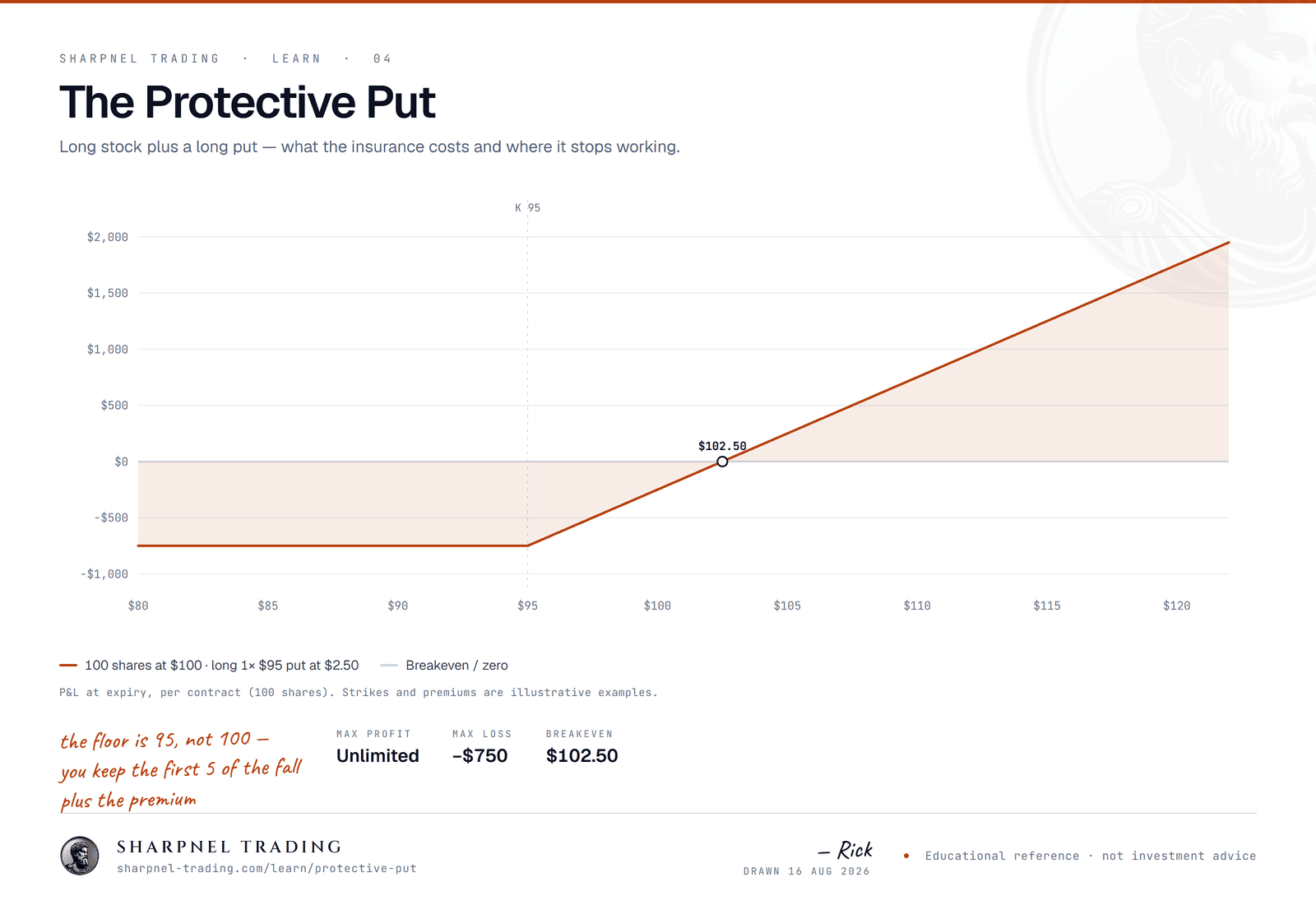
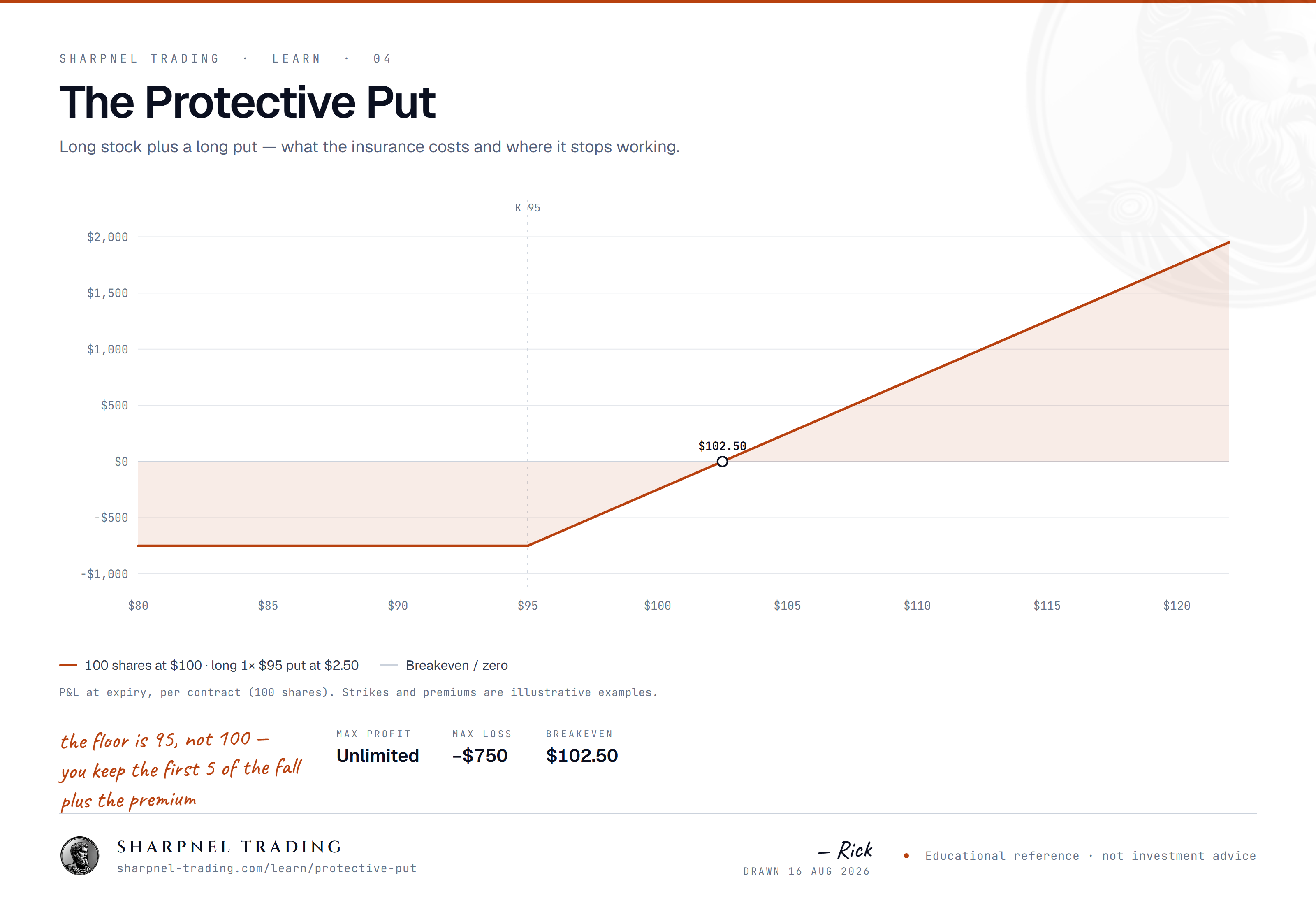
Pricing the floor
The $3.50 put on the $180 stock costs about 1.9% of the position's value for one month of cover. Run that twelve times a year at similar pricing — purely hypothetical, since option prices move constantly — and you'd spend over 20% of the position's value on premium alone. Nobody should pretend that's cheap. Whether it's worth it depends on what the alternative costs, which is the stop-loss question below.
What sets the price:
- Distance to the strike is your deductible. A put 2% below the market costs far more than one 8% below, for the same reason a zero-deductible policy costs more than a high-deductible one. You choose how much first-loss to self-insure.
- Implied volatility is the premium rate. Insurance gets expensive exactly when you want it most. After a selloff, put prices inflate; the cheap hedge was available before the fear, not during it.
- Theta is the meter running. The put loses time value every day the market does nothing. A quiet month is the hedge's worst enemy — you pay full price for protection that was never touched.
There's also an event-pricing trap: puts bought just before a known catalyst carry inflated implied volatility that collapses once the event passes. You can be right about direction and still watch the hedge's value drain.
When the put beats a stop-loss
A stop-loss is free to place, and that's its whole appeal. It's also conditional in ways traders discover at the worst time. A stop becomes a market order once the market reaches its trigger (a stop-limit becomes an order that may never fill), so execution depends on the path the market takes.
Where the put wins:
- Gaps. A stop at $175 does nothing if the stock closes at $178 and opens at $150 — the market order fills near $150. The put holder still sells at $175. In futures, an overnight limit move can leave a stop unfillable while the put's claim on the strike survives untouched.
- Halts. No stop executes during a trading halt. The put's terms don't depend on continuous trading.
- Whipsaw. A stop takes you out at the low; if the market reverses, you're flat and re-buying higher. The put lets you hold through the wick with the loss still capped — you keep the position, which is the point of hedging rather than exiting.
- Known events. Ahead of an earnings date or a scheduled macro print, a stop guarantees nothing about your fill. A put guarantees the strike.
Where the stop wins: markets that trend quietly without gapping. There the stop costs nothing while the put bleeds theta month after month. A disciplined trader who genuinely accepts being stopped out — without revenge re-entry — pays only occasional slippage. The honest framing: with a put, the cost is certain and paid up front; with a stop, the cost is uncertain and path-dependent. You're choosing which kind of loss you'd rather carry, not avoiding loss.
Choosing strike and tenor
Decide the deductible first: how much drawdown are you willing to self-insure? Then look at where downside option interest actually clusters. I check where put open interest concentrates before picking a hedge strike on ES — a heavy put wall below the market marks where dealer hedging activity tends to thicken, and it's a useful reference for where protective strikes are already being priced. (The levels I watch each session are published at /levels.)
For tenor, longer-dated puts cost more in total but less per day; time decay is steepest in the final weeks of an option's life. A common structural approach is buying two or three months of cover and rolling before the decay accelerates, rather than stringing together front-week options. A 0DTE put is a day-hedge around a single session's risk — legitimate, but a different tool; repriced every morning, it makes an expensive and unstable substitute for a standing floor.
Rolling the hedge
A protective put isn't set-and-forget; it expires. Rolling keeps the protection alive, and each version has a cost.
- Rolling up. If ES rallies from 5,600 to 5,700 in our hypothetical, the 5,550 put is now far out-of-the-money and nearly worthless. Sell it, buy a 5,650 put, pay the new premium: the floor ratchets up 100 points and part of the open gain is now protected. You have also just paid for insurance a second time.
- Rolling out. As expiration nears, sell the existing put and buy a later expiry at the same strike, paying the time-value difference. Doing this before the final weeks avoids holding the option through its fastest decay.
- Rolling down (monetizing). After a selloff, the put is in-the-money and rich. Selling it and buying a cheaper, lower strike harvests part of the hedge's gain as a credit — at the price of a lower floor and a wider deductible going forward. Done in fear, it tends to be done badly; write the rule before the selloff, not during it.
Every roll crosses a bid-ask spread, and a hedge rolled monthly crosses twelve of them a year; wider strikes or longer tenors reduce the trip count. One general note for U.S. taxpayers: pairing a put with stock can change how holding periods are treated for tax purposes — a question for a tax professional, not a trading page.
What this position loses
The failure modes deserve plain language. In a flat market, the put expires worthless while theta consumed the premium — repeat that for a few cycles and the drag is material. In a rising market, the hedge again ends with no payout; that's insurance working as designed, but the position trails the unhedged version by exactly the premium spent. At renewal after a volatility spike, the same strike distance costs meaningfully more. And the maximum-loss arithmetic holds when the structure is carried to expiration; exit early and the combined mark depends on implied volatility at that moment.
The protective put earns its price when the risk you're insuring is the kind a stop cannot handle — the gap through your number, the session that never lets you out. It's overpriced when your real risk is a slow grind you could exit with an order that costs nothing. Price the floor before you need it, and budget the premium like any other cost of carrying the position. Then let the numbers, not the fear, decide which positions deserve it.