Theta and vega carry opposite signs
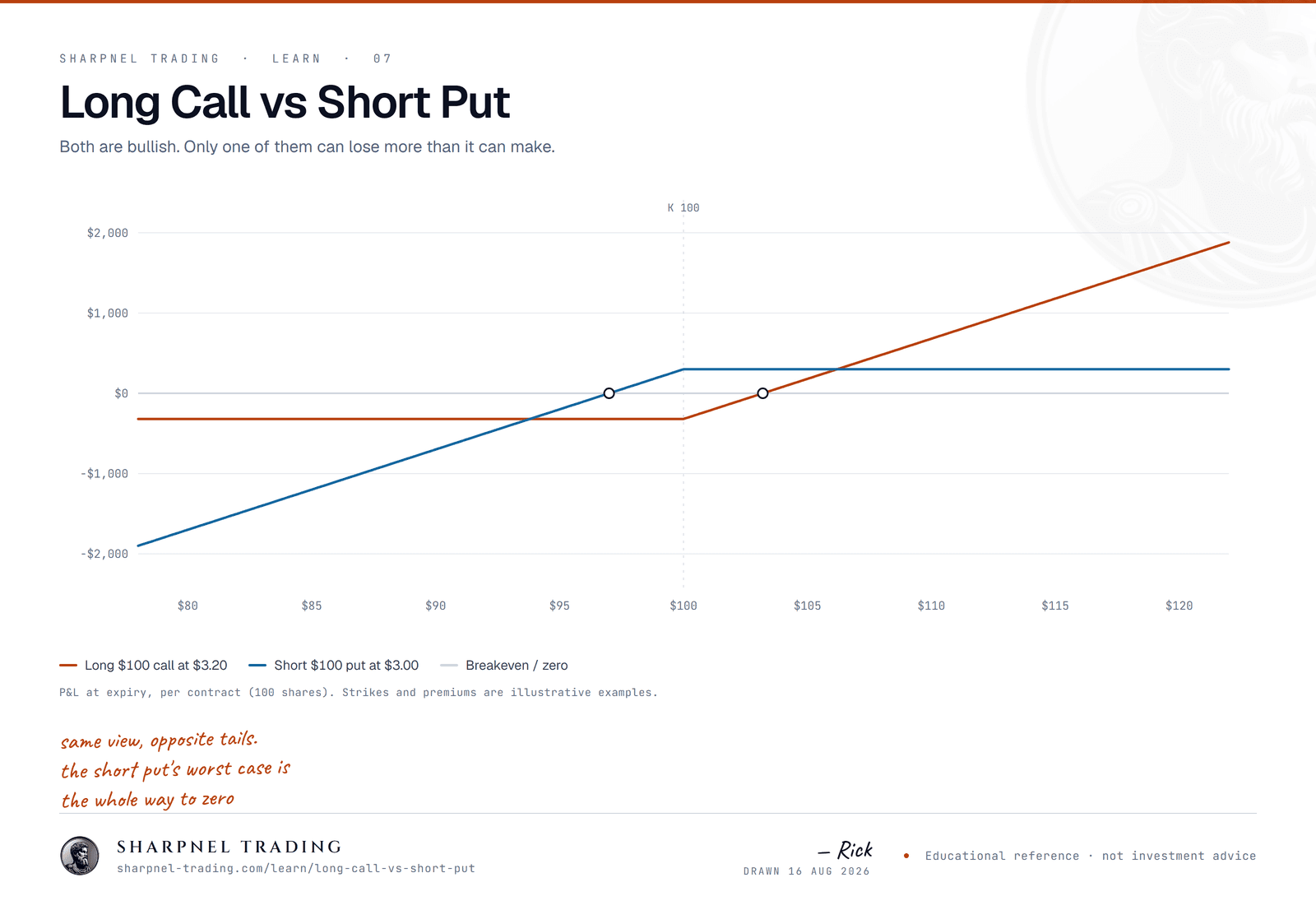
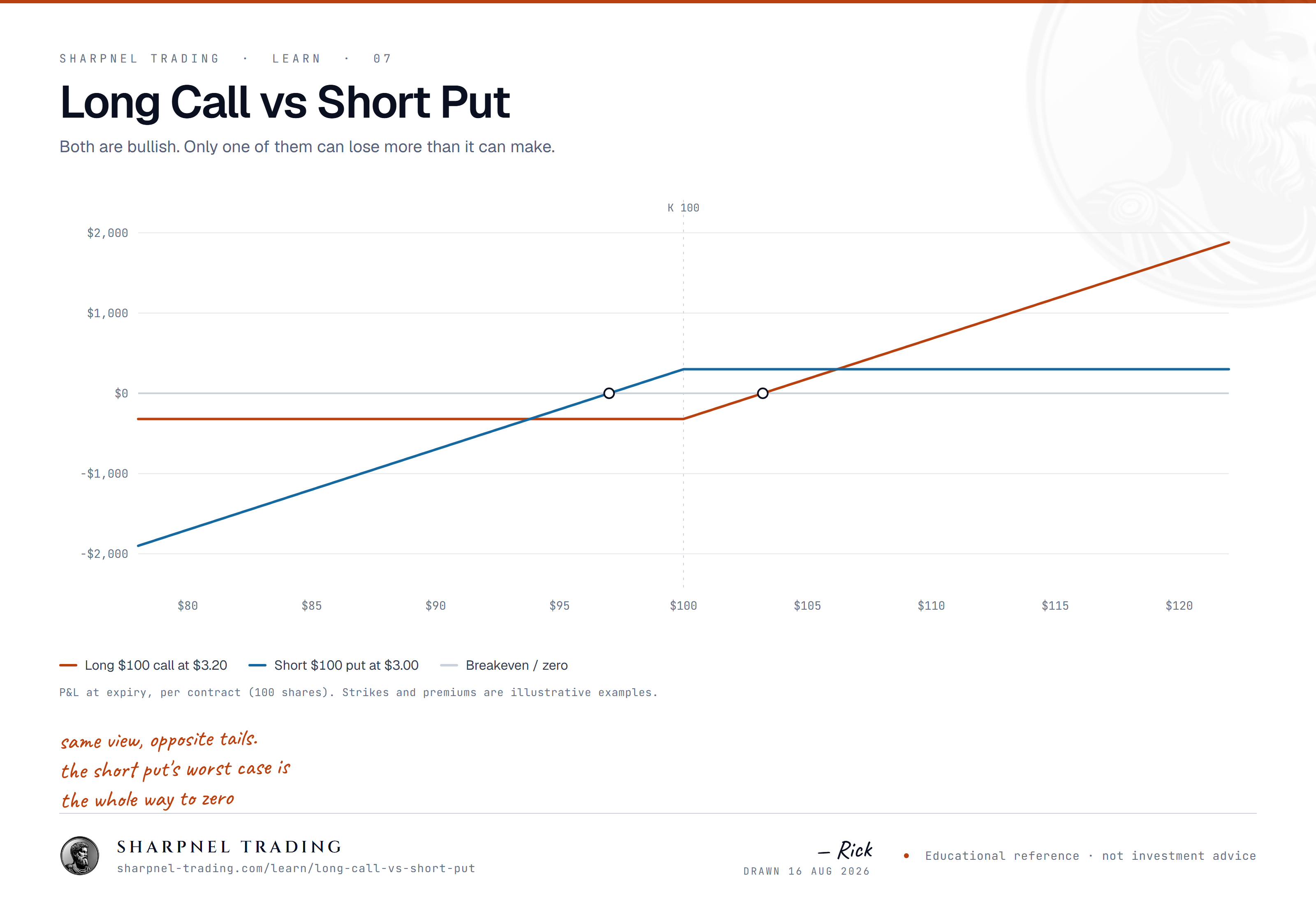
- Long call: theta negative, vega positive. Each day that passes costs value; a rise in implied volatility restores some.
- Short put: theta positive, vega negative. Each day that passes is income; a rise in implied volatility is a mark-to-market loss.
The signs interact with direction in ways that surprise first-time holders. A short put in a selloff loses twice at once — delta against you, implied volatility spiking against you — while its margin requirement climbs. A long call into a scheduled event can be right on direction and still lose: if the move was already priced in, the post-event collapse in implied volatility can take back more than the directional gain delivers. At very short expirations everything compresses into hours;
0DTE contracts are the extreme case, where decay and gamma dominate everything else.
Assignment is a mechanism, not a footnote
US-listed equity options are American-style: a short put can be assigned on any business day, not just at expiration. Early assignment becomes likely once the put trades deep in the money with little extrinsic value left. At expiration the process is automatic — equity options in the money by $0.01 or more are exercised unless the holder opts out — so an in-the-money short put becomes a purchase of 100 shares per contract at the strike, paid for out of your account whether or not the cash was earmarked for it. A close within pennies of the strike adds pin risk: you may not know until the next session whether you own the shares.
Options on futures follow different plumbing. Most are American-style and exercise into a futures position rather than shares, and certain expirations cash-settle instead. The exchange's contract specification page is the authority on exercise style and settlement for each product — the kind of reading best done before expiration week, not during it.
The long call carries no assignment risk; exercise is the holder's choice. The one trap is symmetrical: an in-the-money call left open through expiration will auto-exercise into a position you may not have wanted, or been funded to carry.
Margin: prepaid versus recalculated nightly
The long call's capital requirement is settled at entry. You paid $200; no broker will ever ask for more on that position.
The short put ties up capital in one of two ways. Cash-secured, you reserve the full purchase obligation — $9,300 net of credit in the example — and the position cannot generate a margin call. On margin, brokers typically require a fraction of the notional under a formula recomputed daily, and futures options are margined under risk-based portfolio systems that behave similarly. The direction of the recalculation is what matters: requirements expand as volatility rises and as the option moves in the money, which is precisely when account equity is shrinking. A forced liquidation near the lows turns a drawdown you might have survived into a realized loss. "Undefined risk" slightly overstates the equity case — the stock stops at zero — but the practical boundary is usually margin capacity, not the theoretical floor.
Where each structure fits
The long call
It suits a thesis about a move: a repricing you expect within the option's life, sized so the debit is an amount you can lose entirely. It also suits any rule set that demands a hard cap on risk per position.
Its losing scenarios are time and stillness. A sideways market takes the whole debit. A slow grind higher can lose too, when the gain earns less than the decay costs. Buying calls into events at inflated implied volatility loses even on correct direction. A habit of accumulating cheap out-of-the-money calls bleeds steadily, because most of them expire worthless.
The short put
It suits a thesis about a level: you would genuinely own the underlying at the strike, and the option market is paying acceptably for that obligation. It fits best when the base case is drift or quiet rather than a surge, since time works for the position from day one.
It loses to gaps. A crash delivers the tail all at once — the credit is small against a loss measured from strike to wherever price lands — and the margin expansion described above can force the exit before any recovery. It also disappoints in the strongest rallies: the position earns the same capped amount whether the stock rises 2% or 40% — the most bullish outcomes pay no better than the barely-bullish ones.
One trade, split at the strike
Put-call parity ties the two structures together: at the same strike and expiration, a long call combined with a short put is a synthetic long position in the underlying (financing and dividends aside). Seen that way, the market splits every directional exposure at the strike — the call buyer keeps everything above it and pays to hand off what lies below, while the put seller is paid to accept it. The split is visible at market scale, too. Strikes where put selling concentrates often print as a put wall on positioning maps, and the hedging by dealers on the other side of those contracts is a large part of what gamma exposure measures.
The wheel, and what it actually is
The wheel packages the short put into a cycle: sell a cash-secured put on something you are willing to own; take assignment if it comes and write covered calls against the shares; once the shares are called away, begin again. The short put is the engine.
Its failure modes come with it. A crash assigns you shares into a falling market, and the covered calls available above your cost basis afterward pay very little — capital sits in a drawdown collecting token premium. In a melt-up the puts never assign, and the accumulated credits lag far behind simply having owned the shares. The cash-secured structure removes the margin call, not the loss: the wheel is a short-volatility position wearing income clothing, with full downside exposure to the underlying between credits.
The choice between the two structures is rarely about direction at all. It is about whether your view is specific about time or specific about level, and which shape of being wrong — a certain small cost, or an uncertain large one — your account can absorb. Decide that first; the structure follows.