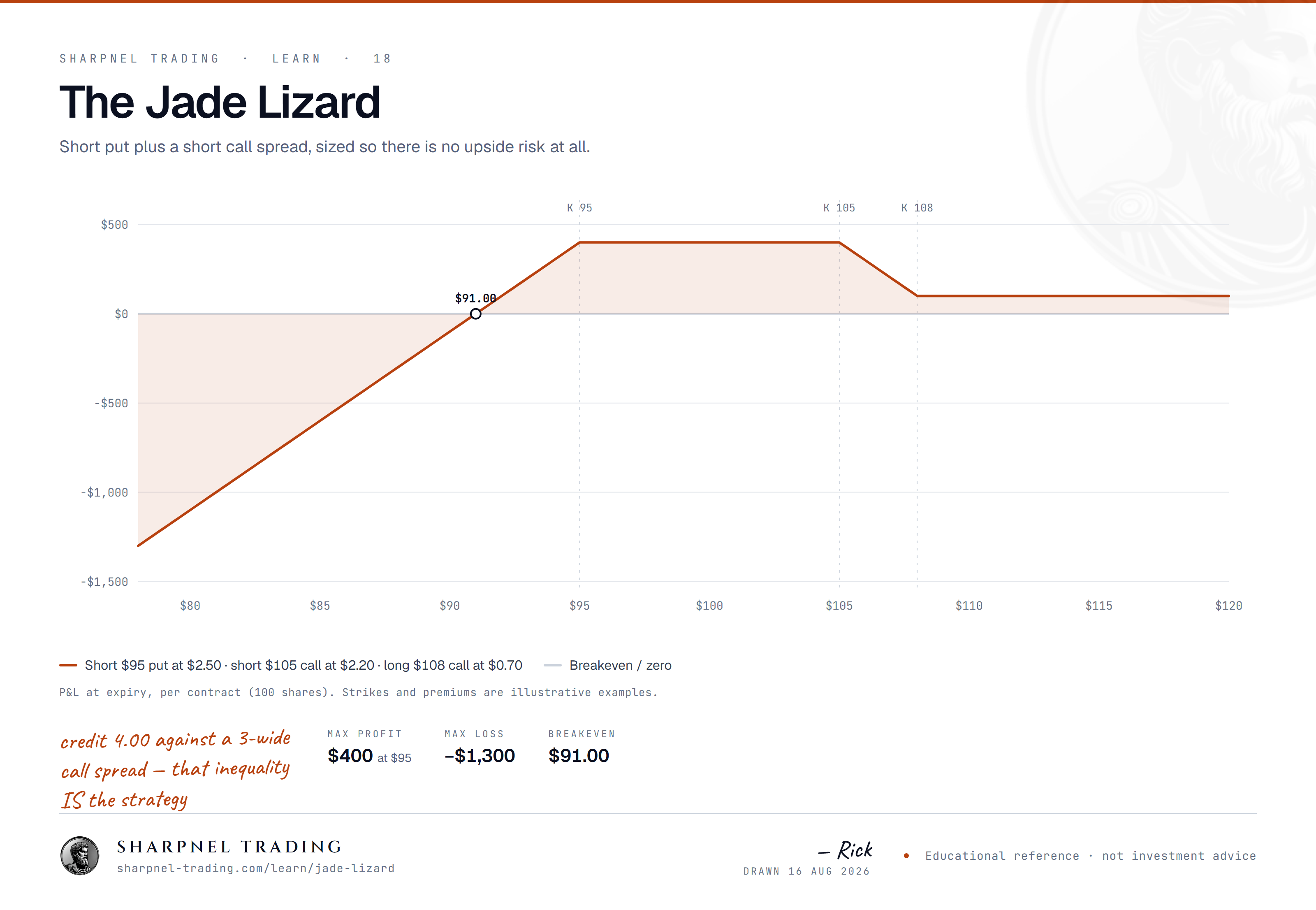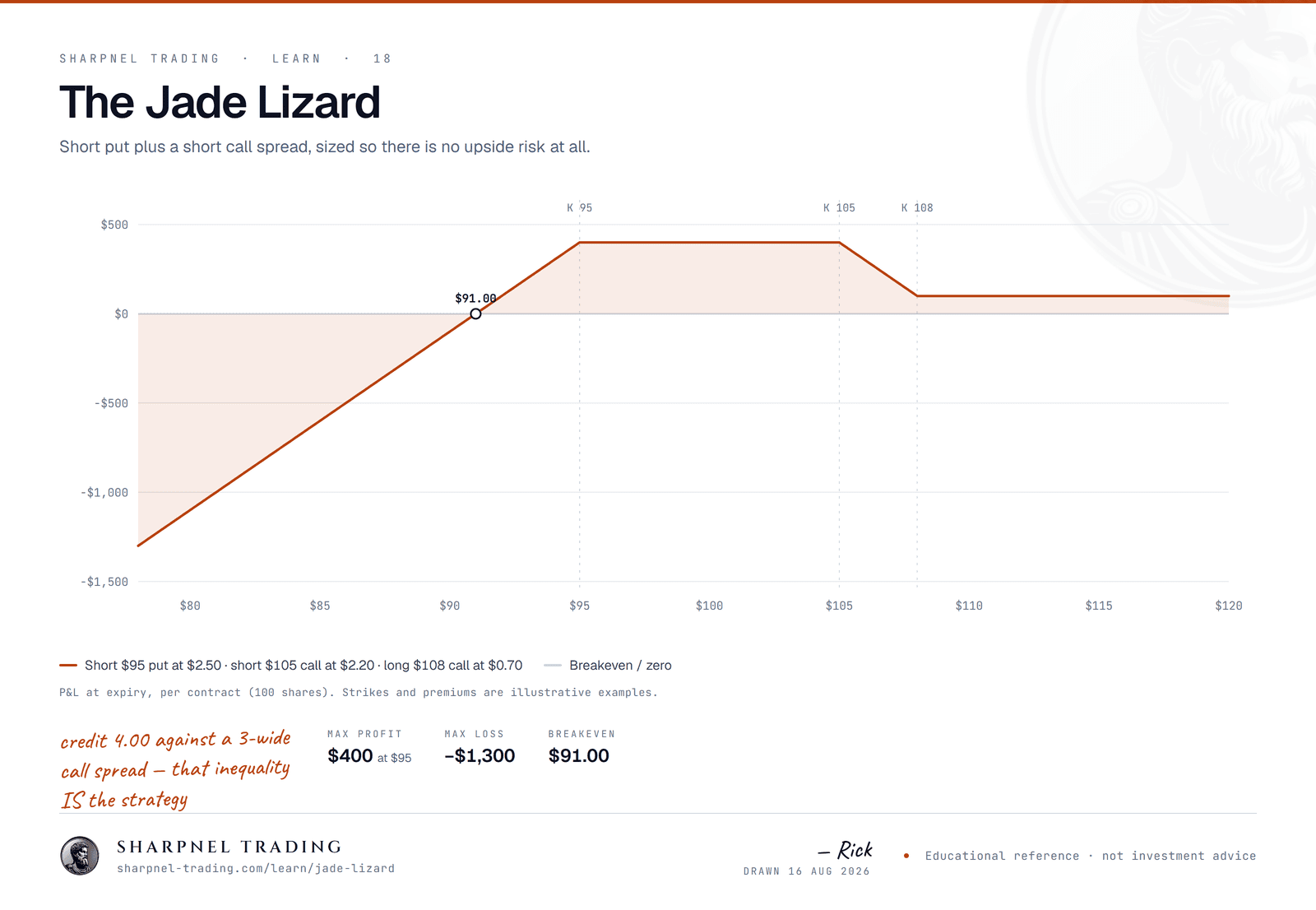
A jade lizard is an options position built from two pieces sold together in the same expiration: an out-of-the-money short put and a short call spread above the market. Both pieces collect premium, and the structure's defining rule is that the total credit must exceed the width of the call spread. When that holds, the position cannot lose on a rally — at expiration, the most the call spread can ever pay out is its width, and the credit already covers it. However far the market runs, the upside finishes at a small, fixed profit.
The risk lives entirely below the market. Under the short put strike, a jade lizard behaves like any short put: losses grow point-for-point with the underlying, cushioned only by the premium taken in. The trade suits a view that a market will hold above support or drift sideways-to-higher, for a seller who wants more credit than a naked put alone pays without accepting risk in both directions the way a short strangle does.
The Three Legs
All in one expiration:
- Sell an out-of-the-money put.
- Sell an out-of-the-money call.
- Buy a further out-of-the-money call.
Equity index skew is why the structure earns its keep. Index puts trade at persistently higher implied volatility than equidistant calls, so the put leg carries most of the premium. The call spread exists to add credit above the market without adding unbounded exposure — and, sized correctly, to push the total past the spread width so the upside seals shut.
The Credit-Versus-Width Test
Net credit ≥ call-spread width → no possible loss above the market at expiration.
Every number below is hypothetical. Say ES trades at 5,600 and you build the position roughly 45 days from expiration:
- Sell the 5,500 put for 24.00 points.
- Sell the 5,650 call for 14.00 points.
- Buy the 5,675 call for 6.00 points.
Check the worst upside case. ES settles at 6,000, far through both call strikes. The put expires worthless. The spread finishes at full width — the 5,650 short call costs 350.00 points while the 5,675 long call returns 325.00, a 25.00-point loss on that piece. Against 32.00 collected, the trade still nets +7.00 points ($350 per contract), and the figure is identical whether ES settles at 5,676 or 7,000. No price above the long call produces a loss.
Now shrink the credit. Had the same strikes brought in only 20.00 total, a settlement above 5,675 would lose 25.00 − 20.00 = 5.00 points. That position is not a jade lizard by the strict definition — it is a capped strangle that still carries upside risk. The entry question is always the same: does the premium clear the width? One caution on thin margins: when the credit beats the width by only a fraction of a point, fees across four legs can flip a mathematically safe upside into a small real loss. I treat anything under a full point of cushion as failing the test.
The Payoff Map at Expiration
With the example position (32.00 credit; 5,500 put; 5,650/5,675 call spread):
- Above 5,675 — flat profit of +7.00 points ($350), locked in by the entry test.
- 5,650 to 5,675 — profit tapers from +32.00 toward +7.00 as the short call moves into the money. A settlement at 5,660 costs 10.00 on the short call, leaving +22.00 ($1,100).
- 5,500 to 5,650 — maximum profit. Everything expires worthless; the full 32.00 ($1,600) stays.
- Below 5,500 — the short put is in the money. Breakeven sits at 5,500 − 32.00 = 5,468. Past it, losses build point-for-point: settle at 5,400 and the put costs 100.00 against 32.00 collected, a net −68.00, or −$3,400 per contract.
Where It Loses
The name advertises the upside; the losses come from everywhere else.
- A hard downside move. The short put's exposure is substantial and, until the underlying reaches zero, effectively open-ended. A gap through the strike skips past every defense you had planned.
- A volatility spike. The package is short vega. Expanding implied volatility marks the position against you even while price sits comfortably inside the profit zone. "No upside risk" is a statement about expiration, not about the path getting there.
- Margin expansion. Futures options are margined under the exchange's portfolio-scanning methodology (SPAN), and requirements rise in exactly the conditions that mark the trade down. A seller sized to calm-market margin can be forced out of a position that would have recovered.
Picking the Strikes
Common conventions among premium sellers — conventions, not rules: the short put near the 25–30 delta, the short call near the 20–25 delta, with spread width chosen last so the combined credit clears it. Wider spreads collect more but demand more credit to seal, which is why many traders keep the width modest.
Dealer positioning gives the strike map context. On ES I look at where the put wall and the call wall sit before placing anything: a short put beneath a heavy put wall sits behind a zone where dealer hedging has historically leaned against declines, and a call spread at or above the call wall parks the short strike where rallies have tended to stall. Those levels move daily — context for strike selection, not a promise about where price stops.
Management
Taking profits
The position earns from time passing while price holds inside the zone. A widely used convention closes at roughly half the credit — in the example, buying the package back at 16.00 banks +16.00 points without holding through the late-cycle gamma window.
When the put is tested
Two standard defenses. Roll the put down and out — later expiration, lower strike — for additional credit, which lowers breakeven at the cost of more time in the trade. Or roll the call spread down toward price, collecting fresh premium; this strengthens the cushion (more credit against the same width) but narrows the profit zone and puts the call side in play on a bounce. Rolling any leg for a debit converts a defense into a larger bet — most sellers simply take the loss instead.
When the call side is tested
If the test passed at entry, a rally is not an emergency. The outcome above the long call is the fixed +7.00 from the example — the decision is whether to close early and free the margin or let the position finish. The short put collapses in value on the way up, which offsets much of the spread's mark against you.
The clock
American-style options on futures can be assigned before expiration, realistically once an option trades near parity. Assignment converts the option into a futures position — a short put becomes long futures at the strike, a short call becomes short futures — with the long call still in place as upside cover. Many sellers close or roll around 21 days out to stay ahead of both assignment mechanics and accelerating gamma. Expiration-week settlement details vary by product and expiry; read the contract specs for the one you trade rather than assuming.
Where It Fits
Against a short strangle, the jade lizard gives up credit — the long call costs real premium — and in exchange cannot lose above the market. Against a naked put, it adds credit and a lower breakeven while accepting a capped best case. The structure is at its best when implied volatility is rich enough that the put pays well and the call spread's contribution is meaningful; in cheap-volatility regimes the credit frequently falls short of the width, and that shortfall is information. A jade lizard you cannot construct honestly is the options market telling you premium is too thin to sell.
It has little business on same-day expirations: a 0DTE version technically exists, but the management half of the trade — rolling a tested put, waiting out a scare — needs time on the clock, and there is none. The put side becomes pure gamma exposure with no second chance.
The test is the trade. Verify credit against width at entry and again after every roll. Below the short strike you own a naked short put in everything but name — size it with that in mind.