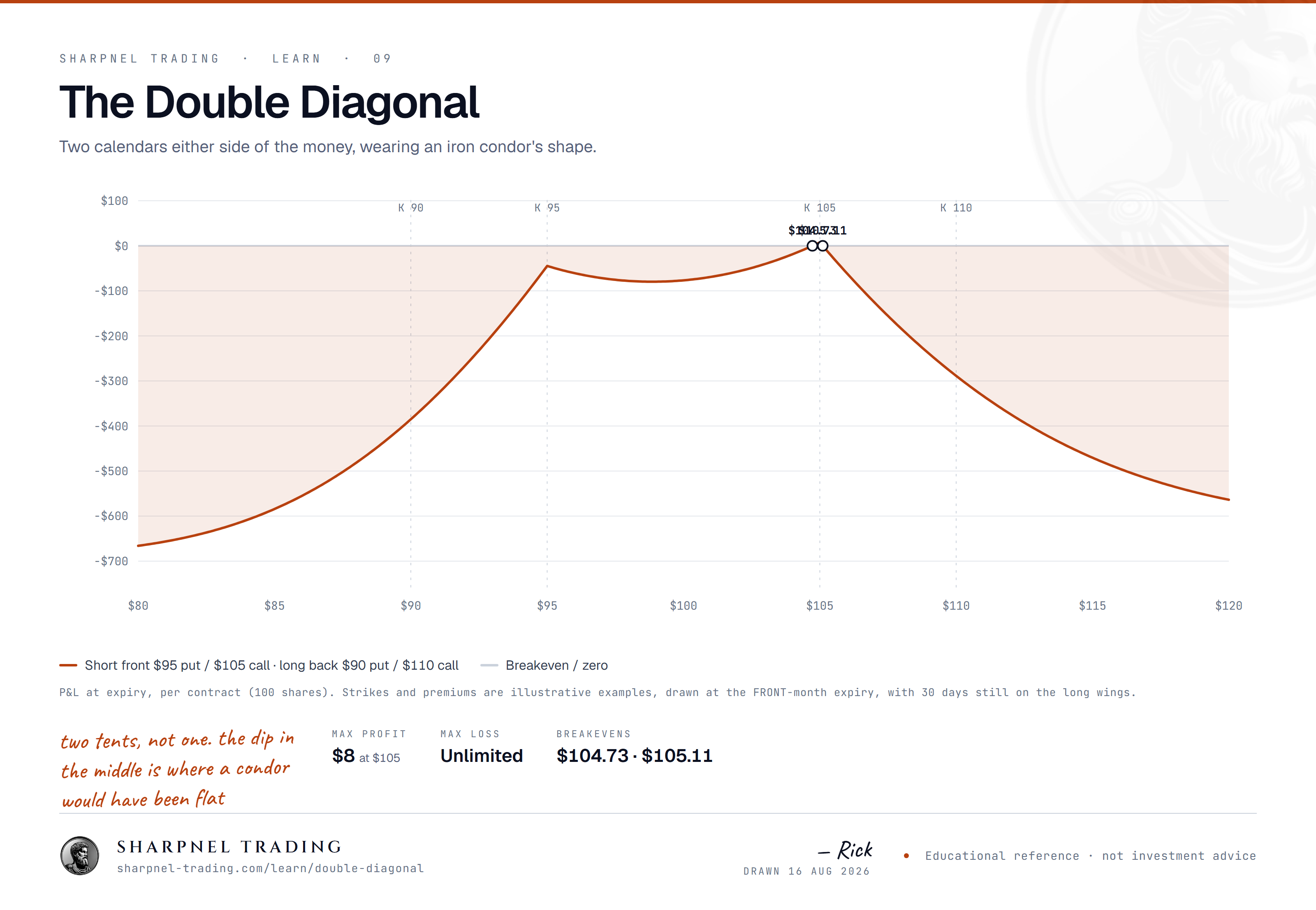
A double diagonal sells near-term premium on both sides of the market while holding longer-dated protection further out-of-the-money on each side. On the call wing you sell a front-expiration call and buy a later-expiration call at a higher strike; on the put wing you sell a front put and buy a later put at a lower strike. Read one way, it is an iron condor whose long options live in a deferred expiration. Read the other way, it is a double calendar whose long strikes have been pushed away from the shorts. Both readings are correct, and the hybrid inherits traits from each parent: the condor's defined wings and the calendar's long volatility exposure.
The position earns when the underlying sits between the short strikes into front expiration while deferred-month implied volatility holds steady or firms. It loses on a fast move through either wing, and it loses — sometimes at the exact settlement price the trader hoped for — when back-month IV drops. Because the long options outlive the shorts, profit at front expiry can never be computed from price alone; it depends on where the deferred month's volatility is marked that day. That single fact separates double diagonals from every same-expiry income spread, and it is the reason to treat the trade as a volatility term-structure position first and a decay collector second.
Construction: a condor with its wings in a later month
All figures below are hypothetical, quoted in index points on an imaginary futures contract trading at 5,000, ignoring multipliers and fees.
- Sell one 30-day 5,100 call at 40.00
- Buy one 58-day 5,150 call at 55.00
- Sell one 30-day 4,900 put at 45.00
- Buy one 58-day 4,850 put at 60.00
Strike placement is where chart work matters. Shorts parked just beyond levels the market has repeatedly respected give the structure room to breathe, and strikes carrying heavy dealer positioning tend to see dampened movement around them while that positioning persists — worth checking against gamma exposure by strike before committing to a wing. I place the shorts off the levels map first and only then look at what the premium happens to be, never the reverse.
Long the back month, short the front: the greeks
Net vega is positive: the deferred longs carry more vega than the front shorts give up, so the package gains when implied volatility rises across both expirations and loses when it falls. Theta is positive while price holds between the short strikes, because 30-day extrinsic value erodes faster than 58-day extrinsic. Delta starts near flat and tilts against you as price approaches either wing.
Gamma is the trap. Far from the shorts and early in the trade, it is mild. In the final week of the front cycle, with price sitting near a short strike, the position becomes sharply short gamma: the short option's delta swings hard on each pass through the strike while the deferred long barely responds. A market that oscillates across a short strike late in the cycle produces losses even inside the intended range — the whipsaw bleed of any short-gamma structure, concentrated into a few sessions.
The tent at front expiry is drawn in pencil
Plot the position's value against price at the moment the front options expire and you get the familiar tent: a raised plateau between the short strikes with peaks near each short, then shoulders falling away beyond the long strikes toward the maximum loss. Unlike an iron condor's expiration graph, this tent is an estimate. The longs still have 28 days of life, so every point on the curve embeds an assumption about where deferred IV will be trading that day.
Run the hypothetical both ways. Settlement at 5,000: both shorts expire worthless, capturing the full 85.00 of front premium. If back-month IV is unchanged and the 5,150 call marks 30.00 with the 4,850 put at 33.00, the remaining longs are worth 63.00 against the 30.00 paid — up 33.00. If deferred IV instead slips three points and those longs mark 22.00 and 24.00, the same perfect pin is worth 46.00 — up 16.00. Identical settlement price, half the profit. Nothing about the price path went wrong; the term structure moved.
Now the losing tail. Settlement at 4,700: the short 4,900 put finishes 200.00 in the money. The short call expires worthless. The long 4,850 put, 150 points in the money with 28 days left, might mark around 175.00; the long call is nearly dead at 2.00. Position value: 175.00 + 2.00 − 200.00 = −23.00, and after the 30.00 debit the trade is down 53.00. Push the decline deeper and the loss approaches the put-wing width plus the debit — 50.00 + 30.00 = 80.00 points here — less whatever time value the surviving long put retains. Defined risk, but a real number to size against before entry rather than after.
One margin note for futures traders: exchange margin on options on futures is scenario-based rather than a fixed spread requirement, so the requirement on a defined-risk structure can still expand when volatility does. Budget for that.
The real underlying: the volatility term structure
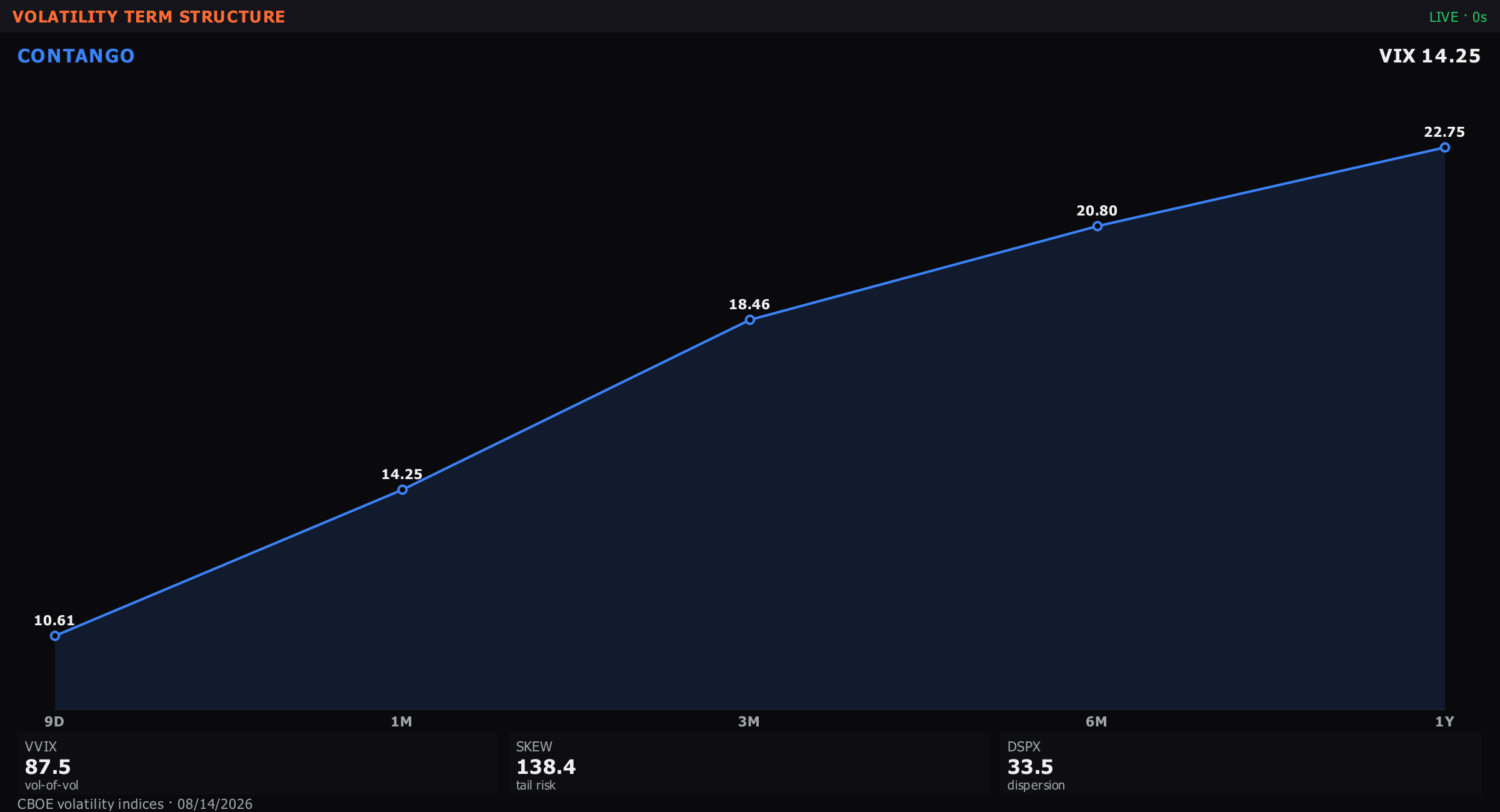
The double diagonal is short front-month volatility against long deferred-month volatility. The favorable entry is a front cycle rich relative to the back — typically when a scheduled release lands inside the front expiration, inflating the options being sold while the deferred month stays comparatively calm. The reverse setup is the quiet failure mode: when the known event sits inside the back month, the longs are the inflated options, and the post-event vol crush lands on the side the trader owns. Checking which expiration holds the event before choosing cycles takes thirty seconds and removes the most common structural mistake in this trade.
A parallel collapse in implied volatility hurts as well, since net vega is long. A grinding, drifting tape after entry pins price nicely but can sink deferred IV enough to eat the front-month decay. In practice this is the routine loser — not the dramatic breach of a wing, but a pin that pays far less than the pencil sketch implied.
Management
Rolling the front
When the short options have surrendered most of their extrinsic value — or the calendar is simply running out — buy them back and sell the next cycle against the same deferred longs. Each roll collects fresh premium and lowers the net basis in the position; a 58-day long can host several successive weekly short cycles before it expires. Discipline lives in one rule: roll for a credit. Paying a debit to chase a breached short strike stacks new risk onto a trade already going wrong; at that point the breached side should simply be closed. Anyone rolling into the final days of a cycle should also respect how much gamma those days carry — the dynamics converge toward 0DTE behavior, where the fight for a strike plays out in hours.
Closing wings
The wings are separable. When one short trades near zero — say the put side after a sustained drift higher — that diagonal has given nearly all it can, and closing it banks the decay while removing half the assignment surface. The remaining wing can stand alone or be recentered by selling a fresh short nearer the market. Closing the tested wing is the defensive version: once price breaches a short strike with days remaining, that wing is a short-gamma liability whose worst case is already known, and taking the loss beats renting hope.
Expiration mechanics force one more decision. Many options on futures are American-style and exercise into a position in the underlying future; a deep in-the-money short whose extrinsic value has collapsed can be assigned before expiration, leaving a futures position with overnight exposure the spread never had. Exercise style and settlement vary by product and by weekly-versus-standard listing, so verify the contract specs for the exact expirations traded. The blunt rule that avoids the whole category of surprise: be out of the front shorts before their final session unless they are far out of the money.
After the front expires
Whatever remains when the front cycle dies is a deferred-month strangle — pure long premium, decaying daily, with no short options financing it. That leftover is a different trade and deserves a deliberate choice: sell new fronts against it and run the structure again, or close it and book the result. Letting it sit unattended converts a range trade into an accidental volatility bet, and the market charges theta for indecision.
The habit that keeps double diagonals honest is marking the position against both of its underlyings — the price of the future and the level of deferred implied volatility — every session, and pre-committing the roll and exit rules before the front cycle's last week arrives, while those decisions are still cheap to make.