Delta, theta, vega: how the legs interact
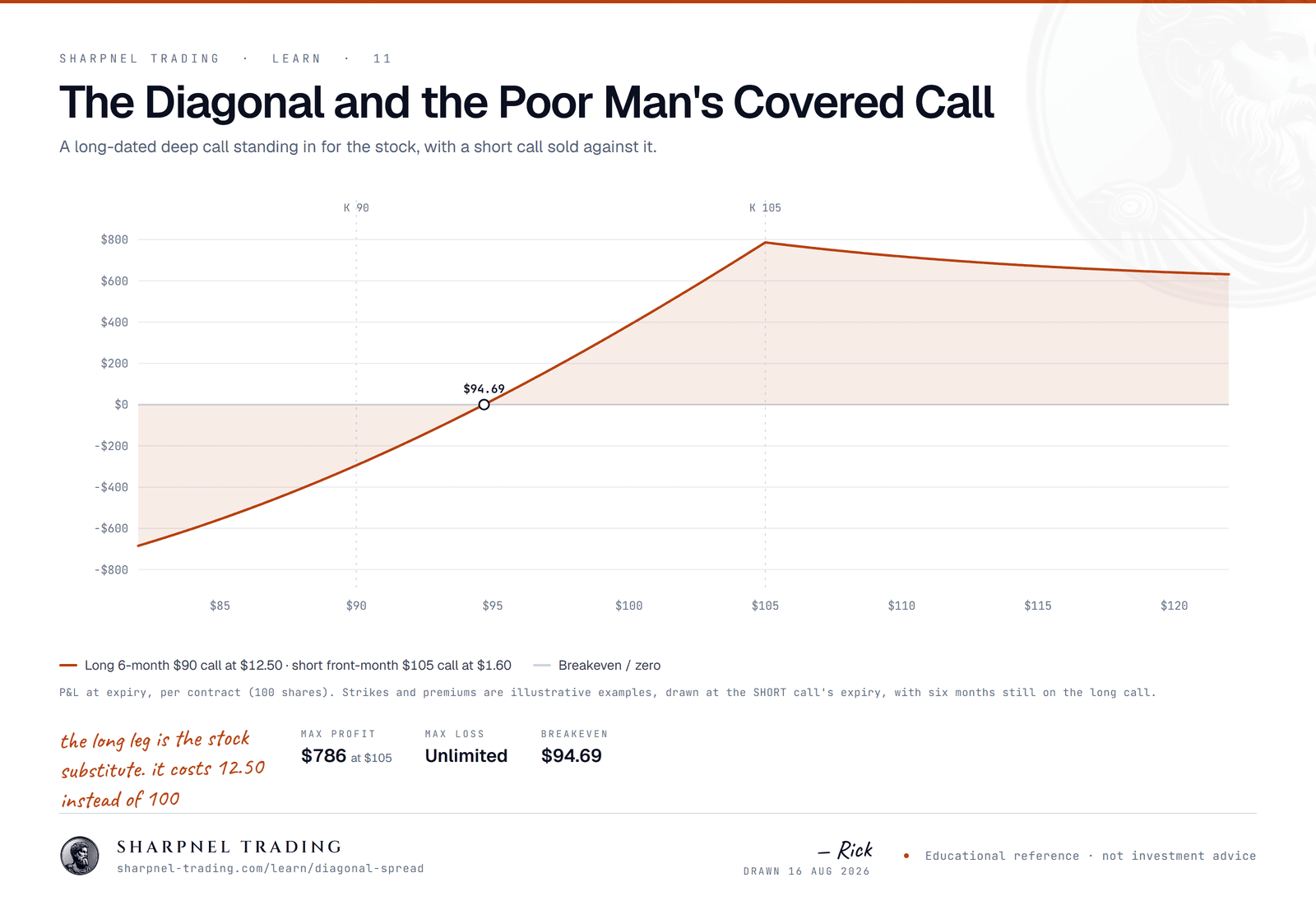
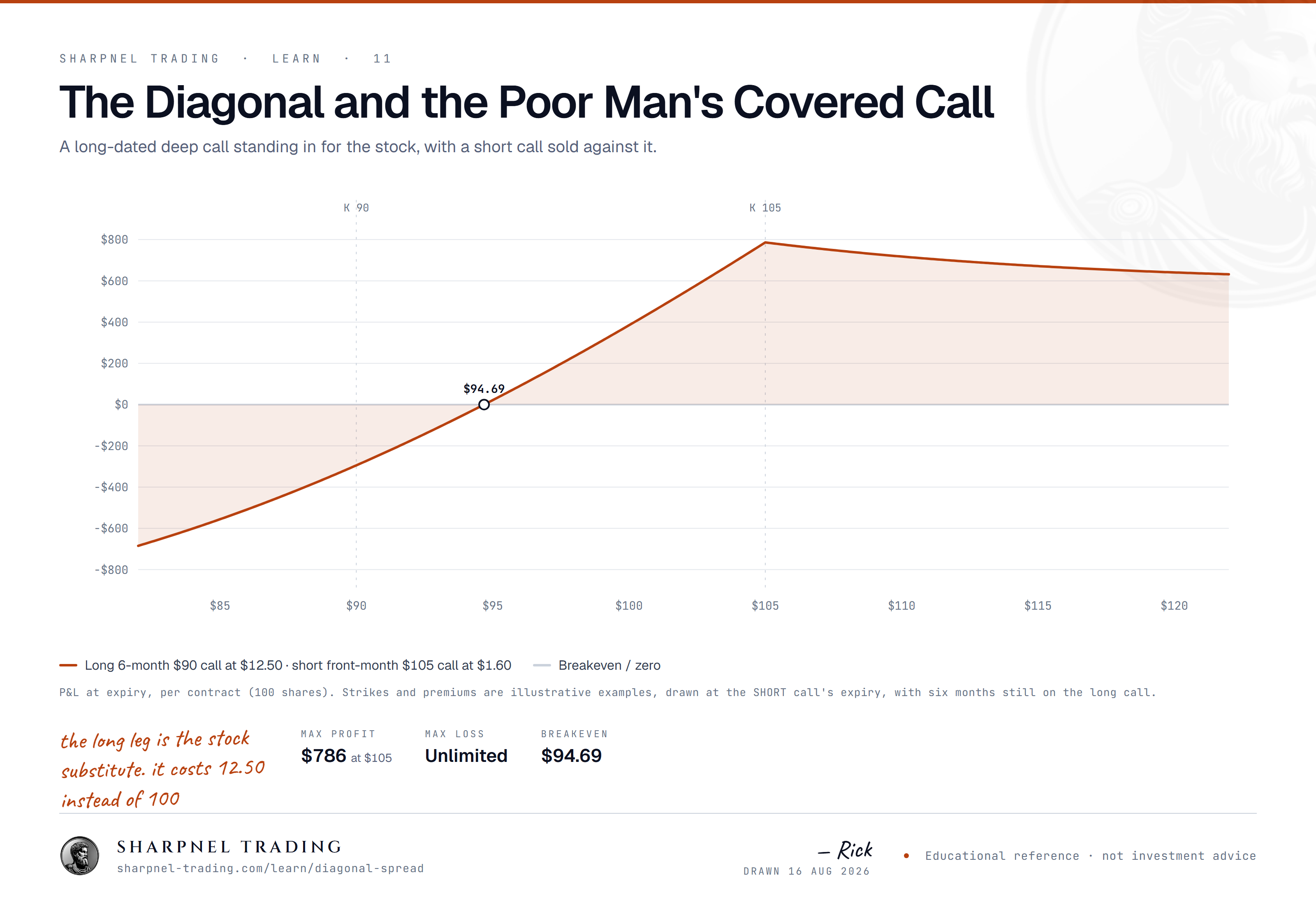
Delta. With a 0.80-delta long against, in this illustration, a 0.15-delta short, net delta is about +0.65 — the position tracks the underlying like a reduced-size stock or futures position, with a hard floor under the loss.
Theta. Decay is not uniform across expiries: a 30-day option surrenders extrinsic far faster per day than a 270-day one. Whether the position collects theta depends on where the extrinsic sits. The PMCC above holds only $3.50 of slow-bleeding time value against $1.20 of fast-bleeding short premium, so it typically earns net theta. Built instead with an at-the-money long leg holding, say, $9.00 of extrinsic against a thin far-out credit, the diagonal can bleed theta despite carrying a short. Deep long leg, meaningful short premium — that ordering turns the structure into an income campaign rather than a slow bleed.
Vega. Longer-dated options carry more vega, so a debit diagonal is usually net long volatility. Rising implied volatility fattens the long leg more than it hurts the short; a vol crush does the reverse — the quiet way these trades bleed: right on direction through an event, yet marked down when implied volatility deflates afterward.
Gamma deserves a footnote. As the short leg nears expiry with spot close to its strike, gamma concentrates sharply — the expiry-week effect that shows up at index scale in dealer gamma exposure — making the final days of each short cycle the most path-sensitive stretch and an argument for rolling early.
Strike width versus credit
Every diagonal prices one trade-off: the closer the short strike, the bigger the credit — and the sooner the upside is capped.
- A near-the-money short might collect $3.00 (again hypothetical) instead of $1.20, cutting the cost basis two and a half times faster. The cost: a modest rally puts the short in-the-money, and in a trending market the structure chronically underperforms plain ownership of the long call — how "safe" tight strikes lose.
- A far-out short keeps the upside open but may collect so little that the credit fails to cover even the long leg's slow decay — a net-decaying long call wearing a spread's costume.
Index traders often park the short strike at or above a positioning zone such as the
call wall, where hedging flows frequently lean against continuation, instead of picking a delta by habit.
The long leg has its own dial. Deeper in-the-money costs more but bleeds less extrinsic and behaves more like the underlying; a shallower long is cheaper but decays faster. Push both legs out-of-the-money and the trade stops being a stock substitute at all, becoming a calendar with a directional lean, ruled by vega rather than delta.
Rolling the short leg
The short call is not one trade; it is a cycle. Standard mechanics:
- Trigger. Once the short trades below 20–25% of the credit collected — or at a fixed line such as 21 days to expiry — buy it back and sell the next cycle.
- Roll out (same strike, later expiry) while spot sits below the strike: routine, and it books a fresh credit.
- Roll up and out after a rally: buy back the in-the-money short, sell a higher strike further out — sometimes for a credit, often for a small debit that is acceptable only because it re-opens room above.
- Track one number: the original debit minus every net credit since. That running basis — not the P&L of any single short — is the position.
Founder note: I log every diagonal as a single campaign with one basis figure. The day I stopped judging each short call in isolation, rolling decisions turned mechanical instead of emotional.
Rolling can also lose. In a grinding downtrend, credits arrive slower than the long leg decays, and rolling the short down to chase premium can pin the short strike below your basis — a recovery rally then locks in a loss no roll can repair. The whipsaw version: pay a debit to roll up, watch spot reverse, and that debit is gone. Rolling manages a position; it does not rescue a wrong thesis.
Assignment on the short leg
American-style equity options can be assigned early, and it clusters around ex-dividend dates: when the short call is in-the-money and its remaining extrinsic is smaller than the coming dividend, a rational holder exercises. If assigned, you wake up short 100 shares against your long call — still hedged and risk-defined, not an emergency.
Responses, in rough preference order:
- Buy the shares back and re-sell a new short call, keeping the long leg intact.
- Close everything — cover the shares, sell the long call, book the result.
- Exercise the long call to cover. Usually the worst choice: exercise forfeits all remaining extrinsic in the long leg, so whatever remains of the example's $3.50 simply evaporates.
Short shares held through the ex-dividend date owe the dividend — exactly why the assignment happened — so act before it, and know how your broker treats the buying-power impact of short stock.
Two settlement caveats for index and futures traders:
- Many broad-based index options are European-style and cash-settled — no early assignment, no shares. Diagonals there reduce to pure mark-to-market management.
- Options on futures exercise into a futures position, margined under the exchange's performance-bond methodology. The subtle trap: legs that straddle a quarterly futures expiration can deliver into different contract months — verify each leg's delivery contract, or wear a calendar-basis exposure the chain never advertised.
The damage in this category is almost always self-inflicted — panic-exercising the long leg, or carrying an in-the-money short through an ex-dividend date unaware.
Pre-trade checklist
- Net debit below the strike width, so a runaway rally still exits ahead.
- Know the extrinsic in each leg — that is the theta sign of the whole position.
- Check the implied-volatility backdrop: a net-long-vega debit opened at rich IV starts the campaign in a hole.
- Decide the roll trigger before entry — a percentage of credit captured, or a fixed days-to-expiry line.
- Confirm settlement style for both legs, and for futures options the exact delivery month of each.
A diagonal is best understood as a financed long option: the market charges a debit for the directional view, and the short-leg cycle works that debit down. Whether the campaign ends ahead depends on the path the underlying takes — the structure defines the risk; it never removes it.