Trading the IV Term Structure
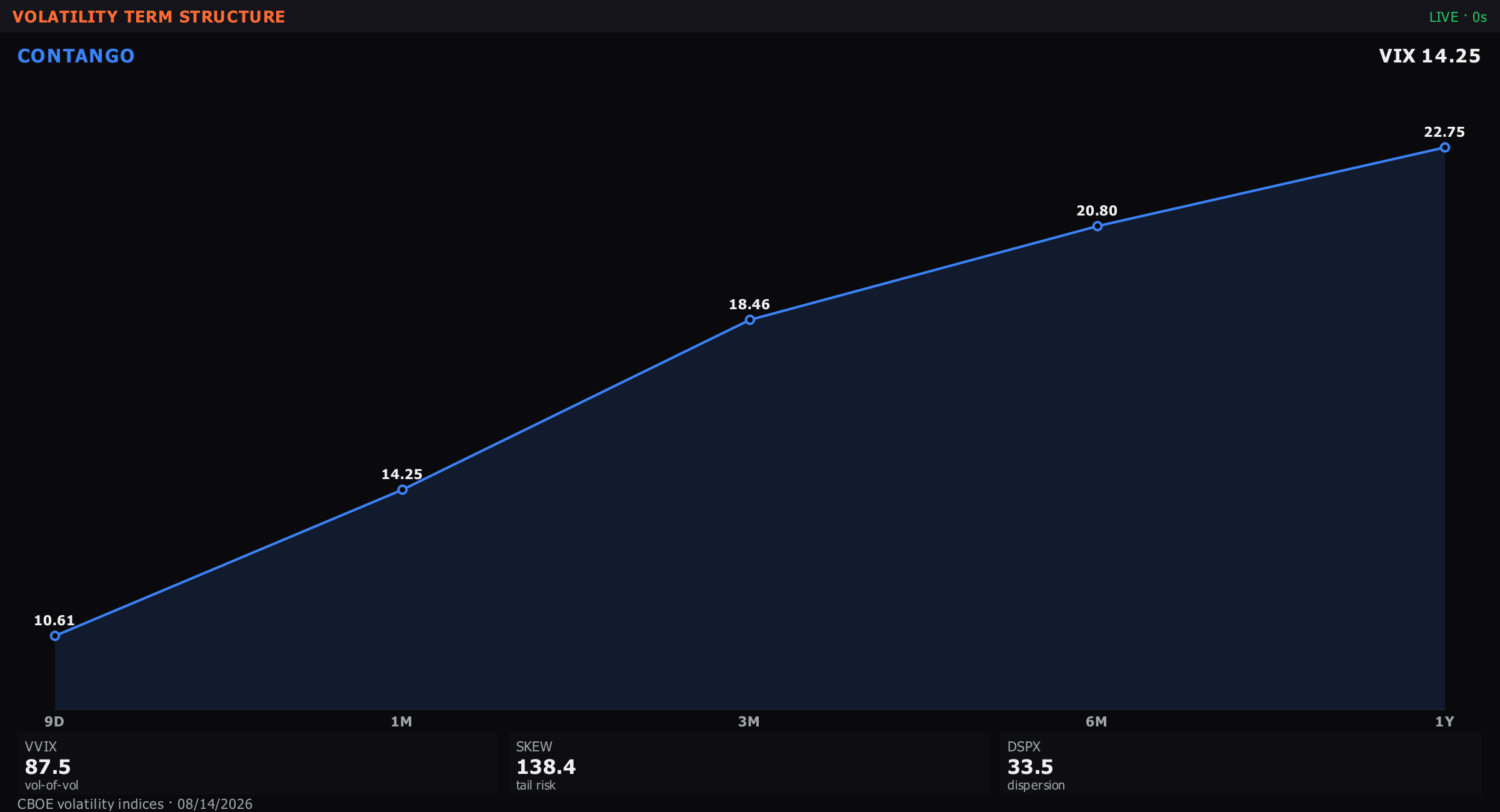
In calm conditions the term structure usually slopes upward — near expiries trade at lower IV than later ones, the options version of contango. Under stress it inverts, front IV spiking above back IV. Around scheduled releases the curve develops kinks: the expiry that captures the event must price the expected move while its neighbors do not.
A long calendar is long the back of the curve against the front, so it gains when the structure steepens or when an inflated front-month premium deflates after an event passes. One warning separates practitioners from textbooks: vega is not fungible across expiries. A single net-vega number on your charting platform treats an IV change as uniform along the curve, but front and back IV routinely move in opposite directions. Track the two IVs separately or the risk figure will lie to you at the worst moment.
I keep front-week versus 30-day ES IV at the top of my notes during CPI and FOMC weeks. The gap is the market's posted price for the event; a calendar is how you take the other side when you think that price is wrong.
Earnings Calendars
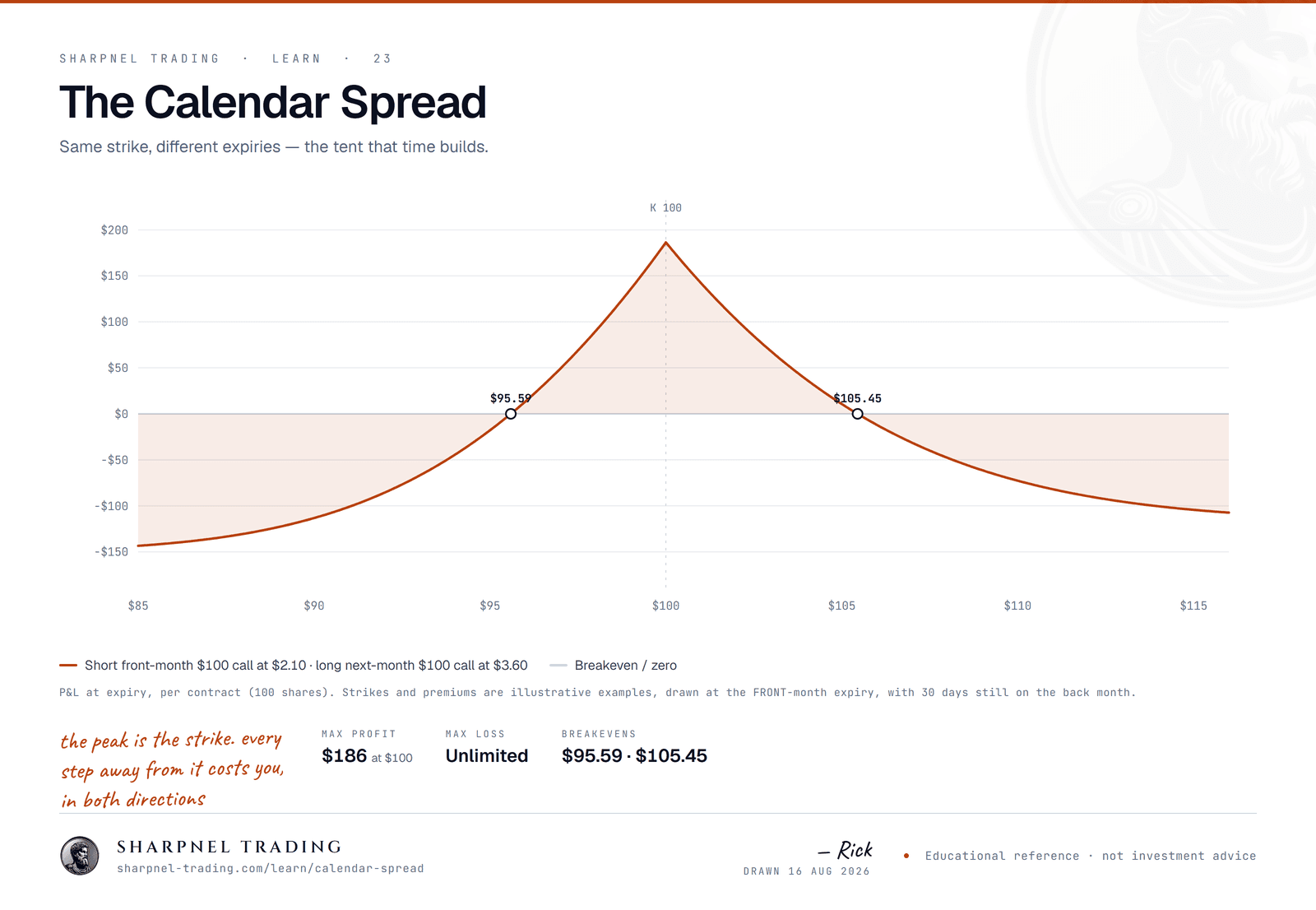
Single-name earnings compress the whole subject into one kink. The first expiry after a report carries the implied move; later expiries carry much less, so front IV can sit dramatically above back IV beforehand. The standard earnings calendar sells that inflated expiry and owns a later one at the same strike, entered shortly before the report. Once the number is out, the event premium in the front evaporates — the IV crush — while the back month deflates far less. If the stock lands near the strike, the spread widens.
What loses: the gap. When the stock moves well beyond its implied move, both options go deep in or out of the money and the spread collapses toward zero — no crush can rescue a strike the stock left behind. Traders widen the landing zone with a double calendar — a put calendar below the market, a call calendar above — accepting a lower peak payoff for a broader range; it fails the same way when the move clears both strikes. US single-name options are American-style and physically delivered: a short in-the-money call carried through an ex-dividend date is a classic assignment surprise.
A reverse calendar — long the front, short the back — bets on inversion instead; it is margin-heavy, and its loss profile is far less forgiving than a debit measured at entry.
A Worked Example
Every number here is invented for arithmetic. Say ES trades at 5,600. Say the 5,600 call with 10 days left trades at 45.00 points while the 5,600 call with 38 days left trades at 92.00. Selling the front and buying the back costs 47.00 points — at $50 per point for ES options, a $2,350 debit, and in the clean case the maximum risk.
Front expiry arrives with ES sitting at exactly 5,600: the short call expires worthless, and with IV unchanged the remaining 28-day call might be worth about 79.00. A spread bought at 47.00 now marks at 79.00 — a gain of 32.00 points, or $1,600.
Same entry, but ES rallies to 5,750 by the front expiry: the short call finishes 150.00 in the money, and say the 28-day 5,600 call trades at 175.00 — 150.00 intrinsic plus 25.00 of time value. The spread is worth 25.00 against 47.00 paid, a loss of 22.00 points, or $1,100. Send ES down to 5,300 instead and both calls are far out of the money; the back month might hold about 10 points with IV unchanged — most of the debit gone, though the volatility spike that usually accompanies an index sell-off would claw some back through the long vega.
Managing the Front Expiry
The last week of the short option's life is where calendars are won and mangled. Gamma on the front leg grows violently into expiration — the same dynamics that power the 0DTE complex — and the practical playbook is short:
- Close the whole spread early. Most of the front option's decay is banked days before it expires; the remaining pennies rarely justify pin and assignment exposure. This is the default.
- Roll the short leg. Buy back the front option and sell the next expiry at the same strike. Each roll collects premium and lowers the basis in the back-month option; rolled several times, a calendar can end up owning the back month for nearly nothing.
- Let it expire and keep the back month. Sensible only when the short is safely out of the money — and the position changes species, from positive theta to a plain long option that needs movement or a volatility bid to pay.
Options on CME equity index futures are American-style and exercise into futures positions: a short ES call assigned overnight leaves you short one future against your long option — hedged, but not the exposure you sized. Pin risk is the ugly edge case: with settlement hugging the strike, you may not learn whether you were assigned until after the close. Expiries do not pin at random — strikes with heavy open interest can act like magnets late in the session, so check the
gamma exposure profile around your strike before carrying the short leg into its final day.
Where Calendars Lose
- A fast move away from the strike, up or down, drains the spread toward worthless — the primary loss mode, and no amount of theta repairs it.
- A broad IV decline hits the long back-month vega harder than the short front leg helps.
- Term-structure inversion — front IV rising against back IV — hurts even with spot glued to the strike.
- Assignment on the short leg converts the trade at an inconvenient hour.
- Back-month options quote wider than front-month ones; the exit spread is part of the cost of the trade.
Treat a calendar as a volatility-curve position with a directional condition attached, not the other way around. If you cannot say which part of the curve is overpriced — and why that gap should close — you are holding a guess dressed as a structure, and the term structure grades it daily whether you look or not.