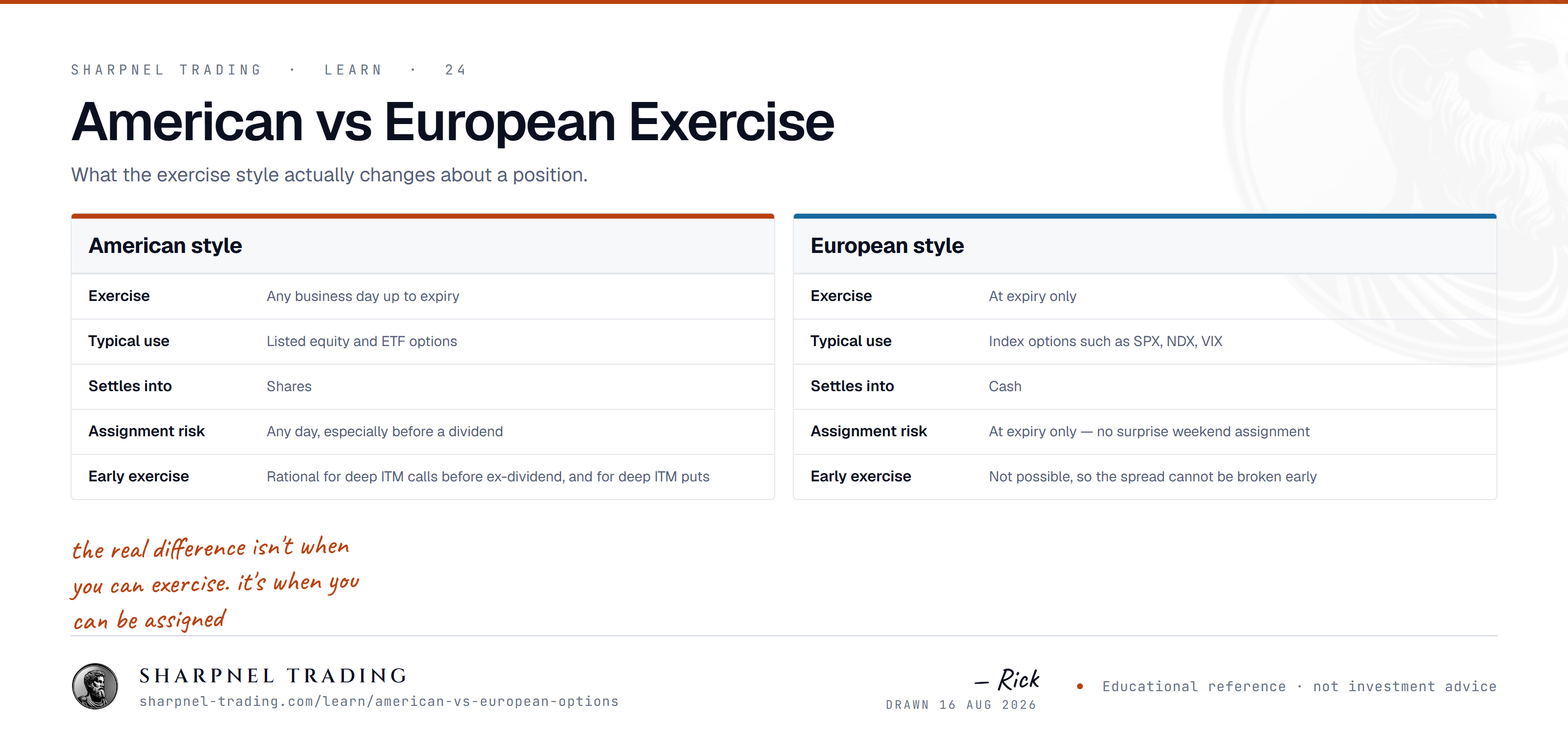
The distinction is one clause in the contract: an American-style option can be exercised on any trading day up to and including expiration, while a European-style option can be exercised only at expiration. Nearly every practical difference between the two follows from that single right — from dividend-driven early exercise to the way a short position can be assigned against you overnight.
The names have nothing to do with geography. SPX index options are European-style and cash-settled; SPY ETF options are American-style and settle in physical shares, and both trade side by side on US exchanges. One misconception is worth killing immediately: exercise style says nothing about when you can trade the contract. A European option can be bought or sold on any day it is listed. Only the act of converting it into the underlying — exercise — waits until the end.
The exercise right is worth less than it looks
Exercising an option collects intrinsic value only. Whatever extrinsic (time) value remains dies the moment you exercise, while selling the option in the market captures both components. So even when you hold an American option, exercising early is usually a mistake — the correct exit is a sale, and the exceptions are narrow enough to enumerate.
The cleanest version of this is a classic result: an American call on an underlying that pays no dividend, in a positive-rate environment, should never be exercised early. Selling it always nets more. Which means the extra premium you pay for American-style calls over a comparable European right is almost entirely a dividend story.
When early exercise actually pays
Calls ahead of an ex-dividend date
Option holders do not receive dividends; shareholders do. On the ex-dividend date the underlying opens lower by roughly the dividend amount, and a deep in-the-money call absorbs that markdown at nearly full delta. The working rule: exercise the day before the ex-date when the dividend exceeds the option's remaining extrinsic value.
Run it on a hypothetical. Say a stock trades at 100 and goes ex-dividend tomorrow for 0.75. You hold the 90-strike call expiring next week, priced at 10.10 — that is 10.00 intrinsic plus 0.10 extrinsic. Exercise today and you own shares at an effective cost of 90; you collect the 0.75 dividend and forfeit the 0.10 of time value, ending about 0.65 per share better off than riding the call through the ex-date markdown (ignoring interest and fees). Reverse the inputs — a 0.10 dividend against 0.75 of remaining extrinsic — and exercising destroys value instead.
The trade-off is real. Exercise swaps a defined-risk option for full share exposure: below the strike the call's loss was capped at its premium, while the shares' loss is not. A stock that gaps down far more than the dividend can cost you a multiple of what the dividend capture earned.
Deep in-the-money puts and interest on the strike
A deep in-the-money put is close to a claim on cash. Exercising a 100-strike put delivers 100 per share now rather than at expiration, and when short-term rates are positive that cash earns interest in the meantime. Early exercise pays once the interest on the strike proceeds exceeds the extrinsic value you would give up.
Hypothetically: a stock has collapsed to 40 and you hold the 100-strike put with 60 days left, quoted at 60.05 — only 0.05 of extrinsic value. With short-term rates at, say, 5%, exercising frees $10,000 of strike proceeds per contract, and 60 days of interest on that is roughly $82. Forfeiting $5 of time value to collect about $82 of carry is the whole trade, which is why deep puts get exercised early in size whenever rates sit meaningfully above zero — and why short deep puts get assigned.
The catch: if you do not already own the shares, exercising a put leaves you short stock, with borrow fees and buy-in risk that can erase the interest edge. Exercise also ends the position's optionality; there is no changing your mind afterward.
Settlement: SPX cash versus SPY shares
SPX options are the canonical European contract. At expiration, an in-the-money option resolves to a cash transfer — the difference between the strike and the settlement value, times the $100 multiplier. No shares move.
The settlement value is where traders get surprised. Traditional third-Friday SPX options are AM-settled: they stop trading Thursday afternoon, and the settlement value is computed from Friday opening prices of the index components. That print can land a long way from Thursday's close. The weekly series, including every 0DTE expiration, is PM-settled against the closing index level instead, which is part of why the short-dated complex behaves so mechanically into the close. I treat AM-settled positions as closed business by Thursday; holding through the morning print is a gap trade, not an option trade.
SPY options are American and physically settled: exercise or assignment moves 100 ETF shares per contract at the strike. That brings pin risk — with the underlying sitting on your short strike at Friday's close, you learn only after the fact whether you were assigned, and the share position you inherit carries weekend gap risk before you can react.
Assignment risk when you are the seller
Every short American option can be assigned on any day, but assignment is not random — it concentrates exactly where early exercise is rational. Deep in-the-money short calls get assigned the night before ex-dividend dates. Deep in-the-money short puts get assigned when the carry math above favors the holder.
The classic blowup is a call spread held through an ex-date. Suppose you are short a SPY call vertical and the short leg is deep in the money with less extrinsic value left than the pending dividend. Assignment overnight makes you short 100 shares per contract — and short shares over an ex-date owe the dividend. The long leg still exists, but the position you now hold is not the one you sized, and the dividend leakage is pure cost. A practical habit: before any ex-date, check the extrinsic value on every short in-the-money call you carry; when it sits below the dividend, assume assignment and act first.
European shorts cannot be assigned early. An SPX iron condor is still an iron condor on its last day, which is the single biggest reason complex-spread traders prefer the index chain. What remains is settlement exposure itself: a print through your short strike becomes a cash debit — the in-the-money amount, capped at the full spread width — with no share position afterward to manage or hedge. Defined risk is still risk — it just resolves in one number.
Where options on futures fit
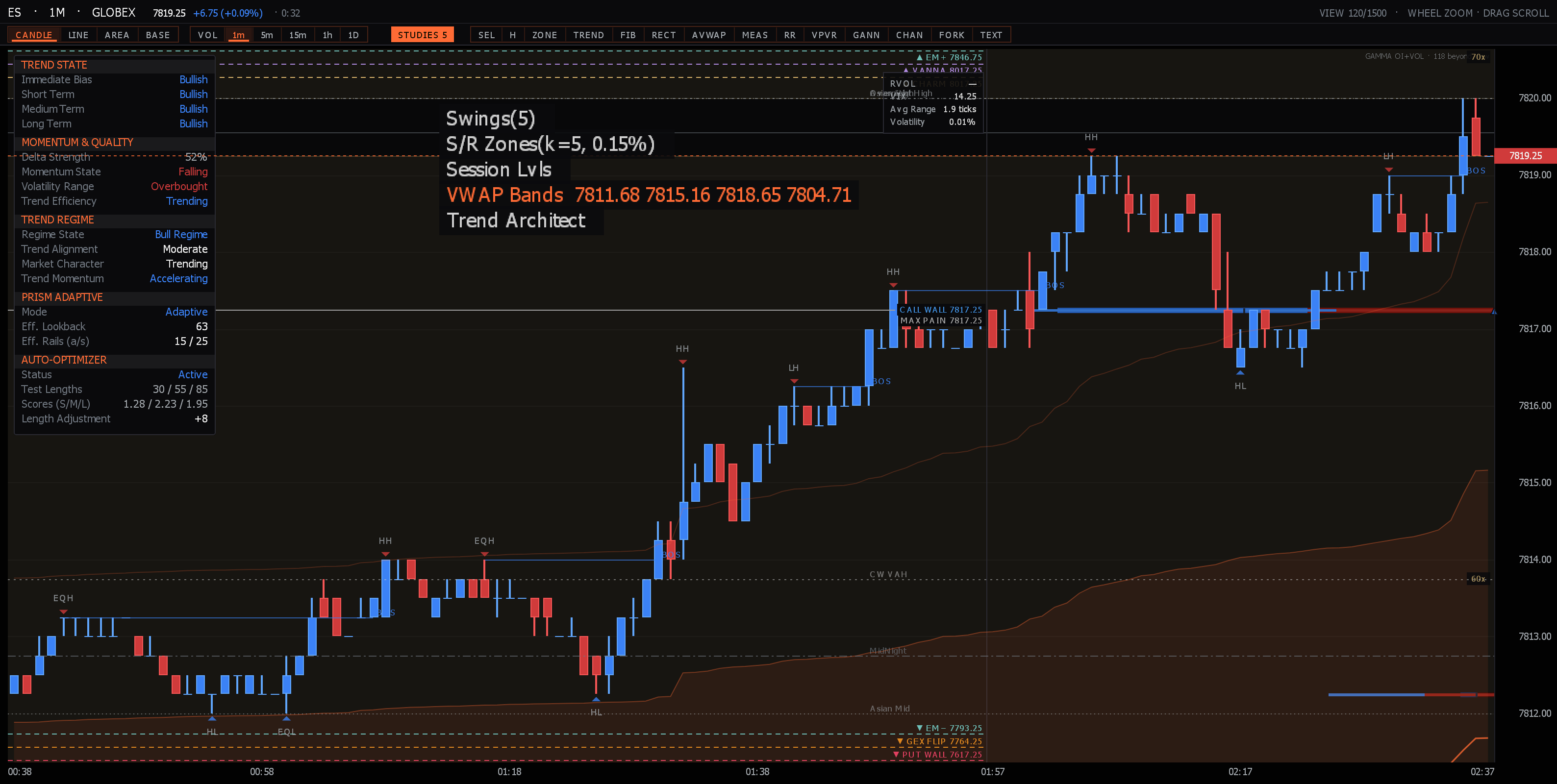
ES options are American-style, but exercise delivers a futures position rather than shares. For a futures trader, assignment is undramatic: you wake up long or short ES at the strike, margined like any other futures position, and you can flatten it the next session. No borrow, no dividend owed — dividends do not flow to futures holders at all, since expected dividends are already embedded in the futures basis. That removes the main early-exercise motive, so early exercise in the ES complex is rare in practice, mostly confined to options trading at parity with essentially nothing extrinsic left.
Why index traders lean European
- Structural integrity. Multi-leg positions keep their shape for their entire life; no leg can be pulled out early by someone else's exercise decision.
- Clean resolution. Cash settlement means no inventory to unwind and no ex-dividend landmines buried in the position.
- Notional efficiency. Say SPX prints 5,600 while SPY tracks near 560: one SPX contract carries about $560,000 of notional against $56,000 for one SPY contract — roughly ten contracts of exposure through one line item of fees and management.
- Tax treatment. In the US, broad-based index options such as SPX generally qualify as Section 1256 contracts with 60/40 capital-gains treatment. That is a general description of the rule, not guidance for your situation.
The pre-trade checklist
- Identify the exercise style of every leg before sizing. Mixed structures — an index option hedged with an ETF option, say — behave differently on each side.
- For short American in-the-money calls, know the next ex-dividend date and compare the dividend to your leg's remaining extrinsic value.
- For AM-settled index positions, decide in advance whether you are willing to hold through the settlement print, and make that part of the plan rather than an expiration-morning surprise.
- For physical-delivery contracts near the strike at expiry, assume assignment is possible and know what the resulting share position would do to your account overnight.