If you trade the index intraday, most of the option activity around you now expires today. And there is an uncomfortable fact about that: the standard way of computing dealer gamma barely sees it.
This is not a criticism of any particular provider. It is a structural consequence of where the input data comes from, and it is worth understanding before you pay anyone for 0DTE levels — including me.
Where the gap comes from
Almost every published gamma-exposure number is built on open interest. Open interest is the count of contracts held at the end of the previous session. It is published once, after the close, by the exchange.
Now consider a 0DTE contract. It is opened and closed inside the same session. It expires today. It was never in yesterday's settled open interest, because yesterday it either did not exist or was a different expiry.
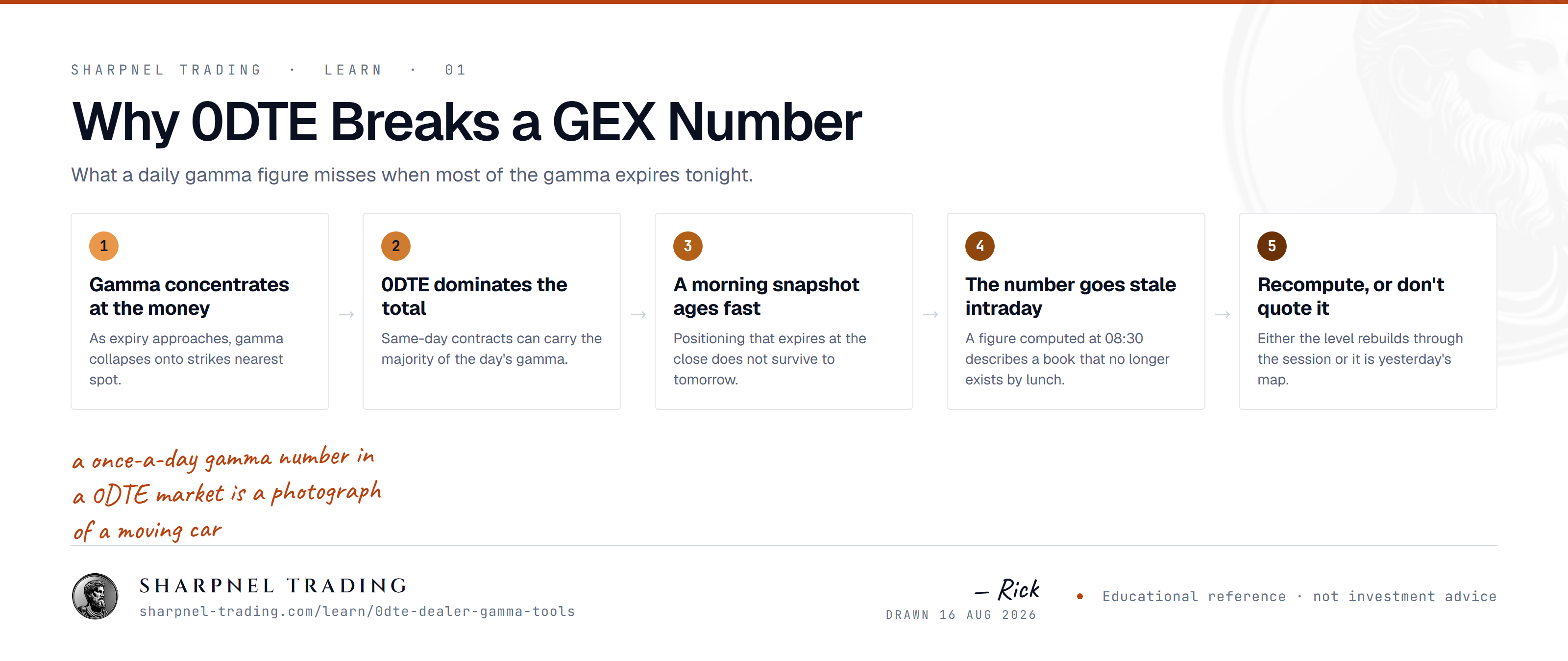
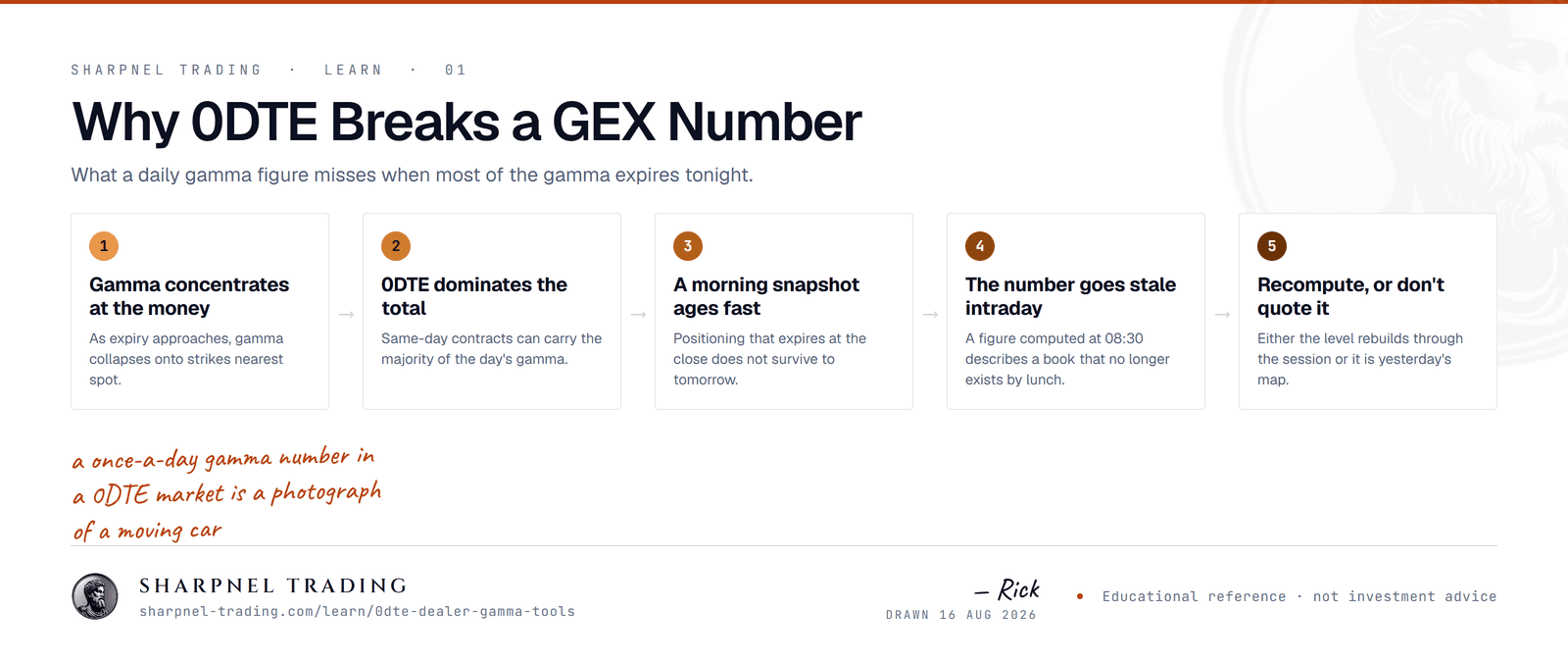
So a GEX figure computed from settled open interest is describing positioning that excludes most of what is being traded right now. The number is not wrong — it is accurately measuring something that is no longer the whole picture.
Why 0DTE gamma is disproportionately powerful
This matters more than the volume share alone suggests, because gamma is not distributed evenly across expiries.
Gamma — the rate at which an option's directional exposure changes as price moves — peaks sharply at the money as expiry approaches. A contract expiring in thirty days has its exposure spread over a wide range of prices. A contract expiring in four hours has enormous sensitivity within a few points of the strike and almost none outside it.
The practical consequence: a relatively small number of 0DTE contracts near spot can generate more hedging pressure than a much larger position in a distant expiry. And that pressure is concentrated in a narrow price band that moves as spot moves.
That is why intraday behaviour around certain strikes can feel violent and specific in a way that a monthly-expiry gamma profile does not explain.